Story code: ST-001799
Part 4: The Dead Stop
The dead plastic on Elias’s wrist was heavy. It felt like the weight of a ghost. The algorithm had severed him, erasing his digital footprint from Fulfillment Center Nine. To the system that governed the lights, the doors, and the conveyor belts, Elias no longer existed.
Mark slid the matte-black smartphone back into his tailored khakis, the operative’s pristine uniform hidden beneath a grimy warehouse apron. “Security will escort you out in three minutes,” Mark said, his voice retaining that sterile, modulated calm. “Your final paycheck will be direct-deposited by midnight. I advise against causing a scene. The cameras are recording.”
Mark turned his back, stepping toward the heavy steel door to wait for the guards. He was a creature of metrics and probabilities, and mathematically, terminated employees always wilted. They always stared at their dead wristbands and waited for the escort to the parking lot.
Elias didn’t wilt. He looked at the crumpled union card on the desk. He thought of Sarah, dragged away in receiving. He thought of the three months of whispers in the camera blind spots, all weaponized against them by the man standing three feet away.
Elias moved.
He didn’t throw a punch-he wasn’t a fighter-but he had spent five years throwing fifty-pound boxes of dog food and industrial solvents. He dropped his shoulder and drove his entire body weight directly into Mark’s back. The operative slammed face-first into the cinderblock wall with a sharp gasp, his phone clattering violently to the linoleum floor.
Before Mark could recover, Elias lunged for the door. Fire code dictated a manual crash bar on the inside of every room, regardless of electronic deadbolts. Elias slammed both hands into the heavy metal bar. The locking mechanism disengaged with a loud crack, and Elias threw his weight against the steel, bursting out of Bay 4 and back into the blinding fluorescent glare of the warehouse floor.
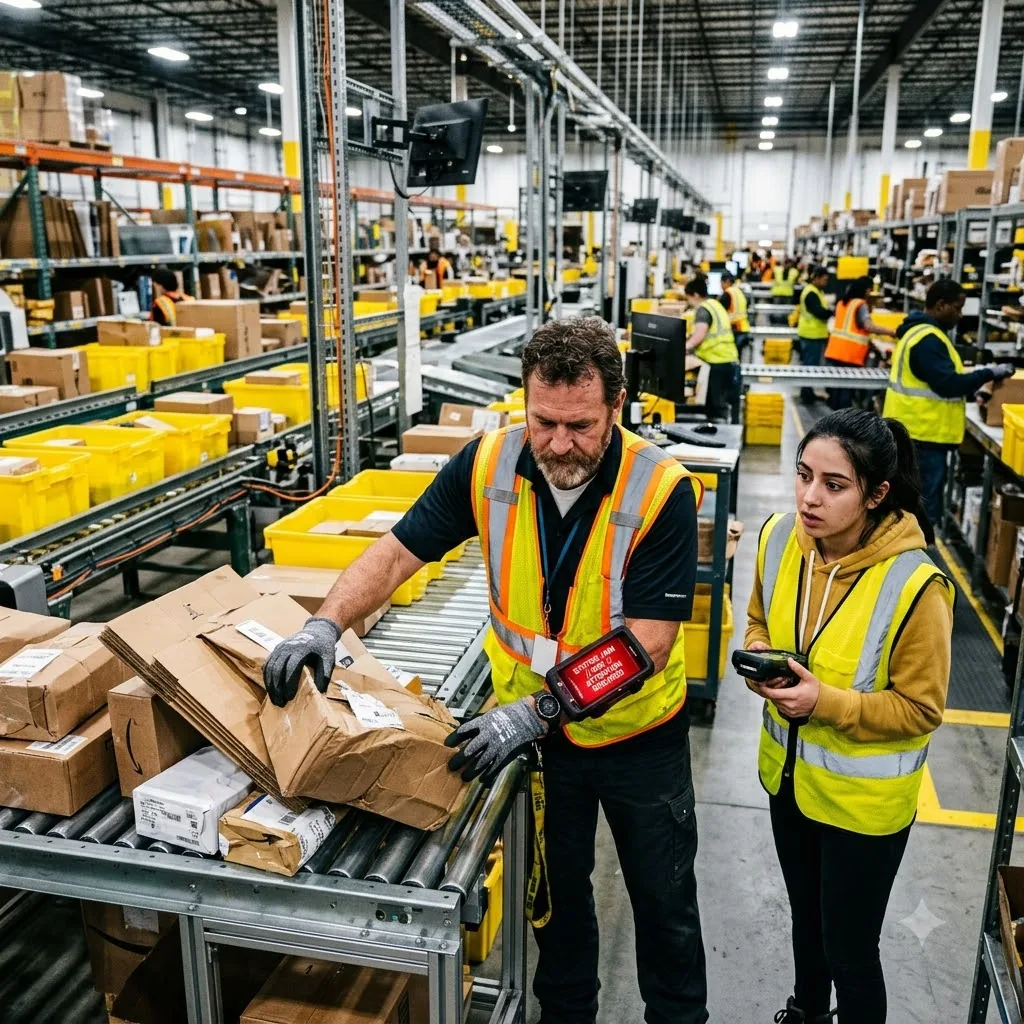
The industrial roar of the regional line hit him like a physical wall, a ninety-decibel tidal wave of grinding gears and whining belts. The main floor was in a state of suppressed chaos. Supervisors in reflective vests were marching through the aisles, systematically pulling bewildered union members from their stations. The remaining workers kept their heads ducked, scanning faster, terrified of the red lights flashing on their own wrists. Empathy was dangerous. Looking up was inefficient.
Elias sprinted down the central walkway, ignoring the yellow safety railings.
“Hey!” Reynolds shouted from Bay 2, dropping his management tablet. “Stop him!”
Elias’s boots pounded against the concrete. His lungs burned. He bypassed the packing stations and the forklift lanes, weaving through the labyrinth of towering steel racks. He was heading for the mechanical heart of Fulfillment Center Nine: the primary regional sorter. It was a three-story behemoth of overlapping conveyor belts that processed fifty thousand packages an hour.
The heavy-set security contractor lunged at him from a cross-aisle, but Elias pivoted his hips-using the exact same muscle memory he relied on to scan barcodes without turning heavy boxes-and slipped past the man’s grasping hands.
He reached the massive yellow control pillar at the base of the regional line. Behind a thick plexiglass guard sat the master emergency-stop button. It was a massive, palm-sized red dome.
Elias grabbed the edge of the plexiglass cover and wrenched it backward. The plastic cracked, snapping off its hinges. He slammed his open palm onto the red dome.
The result was instantaneous.
The screech of locking airbrakes echoed through the cavernous building. The massive belts lurched and violently halted, sending thousands of cardboard boxes sliding into metal guardrails. The automated floor-sweepers powered down in the aisles. The sorting scanners went completely dark.
Then came the silence.
It was sudden and entirely unnatural, a heavy, ringing quiet that pressed down on the massive warehouse. For the first time in five years, Elias could hear his own ragged breathing. He could hear the squeak of rubber soles on concrete.
Every single scanner gun dropped. A hundred workers stepped out from behind their metal racks and picking stations, their eyes wide, staring down into the central aisle. The algorithm demanded they keep working, but the machine had stopped.
Elias scrambled up onto a yellow sorting bin, elevating himself above the sea of frozen employees. He saw Mark burst out of Bay 4, flanked by security, scanning the room with a sudden, uncalculated panic.
Elias filled his lungs with the stale, recycled air and screamed into the absolute silence.
“His name is Mark!” Elias roared, pointing a trembling finger directly at the operative. The sound of a human voice echoing unhindered across the warehouse floor was jarring, almost alien. “He’s a corporate spy! They didn’t catch us on camera! They put him on the floor to beg for help! Anyone who stepped off their mat to save his metrics got logged!”
Reynolds and the contractor were sprinting toward the pillar, but they were thirty yards out. The workers on the floor were entirely still, listening.
“They used our humanity against us!” Elias shouted, his voice cracking but booming off the corrugated steel roof. “They just fired fifty people because we wouldn’t let him drown! The algorithm is blind! It only saw who cared!”
The security contractor hit the yellow bin, wrapping thick arms around Elias’s waist, dragging him backward. Elias fought, clinging to the metal edge of the conveyor belt, refusing to be silenced.
“Sunday!” Elias screamed as he was pulled down to the concrete, fighting through the contractor’s chokehold. “Sunday at the community center basement! Eight p.m.! They can’t fire all of us if the line doesn’t move! They can’t fire the whole shift!”
They pinned him to the floor. The cold concrete pressed against his cheek as Reynolds frantically typed on his tablet, desperately trying to override the physical emergency stop. The overhead sirens finally kicked in, a wailing mechanical screech, but it was too late.
Elias lay pinned, his chest heaving, his dead wristband scraping against the grit of the floor. He looked up at the towering aisles.
Nobody was looking at their dead screens. Nobody was looking at their penalty lights. A hundred workers stood at the edges of their anti-fatigue mats, staring down at Mark. The operative stood completely still, his tailored posture and calm demeanor entirely exposed, surrounded by a sea of hostile, awake eyes.
The machine was broken, and in the silence it left behind, the fear was gone.