Story code: ST-001534
Part 2: Strict Liability
Hayes shifted his weight, his thick, reinforced boots squeaking harshly against the polished linoleum. He glanced nervously at Warden Vance before answering the attorney’s demand. “The cell search was executed at zero-seven-fifteen hours,” Hayes stated, forcing his voice to remain flat and authoritative.
Sterling let out a sharp, dismissive scoff that echoed loudly down the sterile cinderblock corridor. He reached into the breast pocket of his tailored navy suit and produced a folded piece of crisp white paper. “This is the official transport manifest I secured from the intake desk twenty minutes ago. My client was removed from his housing block and placed into the secure holding cell outside this hearing room at exactly zero-six-fifteen. That is a full hour before your unannounced search, Officer Hayes. An hour during which cell block doors were opened for breakfast rotation, leaving Teo’s bunk entirely unsecured and easily accessible to the eighty-four other inmates on that tier.”
Teo felt a fleeting, desperate surge of hope beneath the crushing weight of his panic. Sterling was aggressively earning his exorbitant retainer fee. The logical defense was airtight. It proved the unauthorized pillowcase could have been tossed under the mattress by literally anyone holding a grudge while Teo was locked in a holding cage on the other side of the compound.
Warden Vance, however, did not look remotely deterred. In fact, his relaxed, performative smile only widened. He stepped smoothly between Sterling and the guard, effectively shielding Hayes from the attorney’s aggressive, forward-leaning posture.
“A valiant defense, Mr. Sterling,” Vance said, his voice dropping into a low, intensely patronizing register. “However, the state Department of Corrections operates on the absolute principle of strict liability regarding cell inventory. An inmate is solely and legally responsible for every single item found within their designated square footage, regardless of their physical presence at the time of discovery. The infraction stands as written.”
Sterling squared his shoulders, the expensive pinstripe fabric pulling taut across his chest. “That is an absurd, malicious application of the rule, Warden. I will bring this manifest immediately to the parole board. They have the administrative discretion to overlook a pending, unverified write-up.”
“The board has discretion over many things,” Vance agreed effortlessly, smoothing a hand over his silver hair. “But they do not have jurisdiction over internal facility security. If you intend to formally contest this infraction on your client’s behalf, we are required by state mandate to launch a full administrative probe. We must interview the other eighty-four inmates on the tier. We must review security footage.”
Vance paused, letting the silence stretch out in the cold, buzzing hallway. “A probe requires time. Four to six weeks, typically. And during any active investigation into contraband, the inmate in question is automatically classified as a severe security risk.”
Teo’s breath hitched painfully in his throat. He knew exactly what that specific classification meant.
“To prevent evidence tampering or witness intimidation,” Vance continued, looking down at Teo with dead, unblinking eyes, “Teo will be immediately transferred to Administrative Segregation until the probe concludes. Solitary confinement. Twenty-three hours a day locked behind a solid steel door.”
The hallway felt as though all the oxygen had been instantly vented into space. Teo’s heart slammed against his ribs in a frantic, trapped rhythm. Solitary confinement was designed to mentally break men. But far worse than the psychological torture of the isolation was the administrative timeline. Four to six weeks meant the parole hearing today was entirely dead. It meant Maria’s predatory title loan would default long before Teo ever saw the inside of a courtroom again. Sterling’s retainer would be completely exhausted just fighting the administrative delay.
“You are weaponizing protocol to circumvent a legal proceeding,” Sterling said, his voice dropping its theatrical volume, replacing it with a dangerous, quiet edge. “This is a coordinated, retaliatory deprivation of my client’s civil rights. I will file a federal injunction by noon.”
“You are welcome to file whatever paperwork you please, Counselor,” Vance replied smoothly, completely unbothered by the threat. “But the federal courts move incredibly slowly. And the title loan your client’s sister took out-the one accumulating an annual percentage rate of over three hundred percent-moves very, very fast.”
Teo’s head snapped up. The heavy steel chains connecting his wrists rattled loudly against the metal bench. The blood roared in his ears. How did the warden know about the title loan? That was a highly private financial transaction Maria had made on the outside. Teo had only spoken about it with Sterling in the confidential attorney-client visiting room. Prison phone calls were actively monitored, but Teo had explicitly warned Maria never to discuss their money problems on the recorded lines.
Vance noticed Teo’s profound shock and gave a small, approving nod. The warden slowly tapped his manicured index finger against the thick manila folder tucked under his arm. For the first time, Teo noticed the secondary label affixed to the front of his permanent file. It wasn’t a standard Department of Corrections barcode. It was a glossy white sticker bearing a bold, black corporate logo: *Omni-State Logistics*.
Teo recognized the name instantly. It was the exact same massive county logistics center where Maria worked the grueling graveyard shift. It was also the parent corporation that had recently won a highly controversial state contract to utilize prison labor for their packaging, fabrication, and fulfillment warehouses.
“So here are your client’s options, Mr. Sterling,” Vance said, his tone entirely conversational, as if they were discussing the weather. “Option one: Teo formally contests the infraction. I place him in solitary confinement. We cancel today’s hearing. You spend the next month billing his sister into permanent bankruptcy while he rots in the hole, and she loses her car anyway.”
Vance leaned closer, his expensive cologne smelling entirely out of place amidst the scent of cheap floor wax and stale sweat.
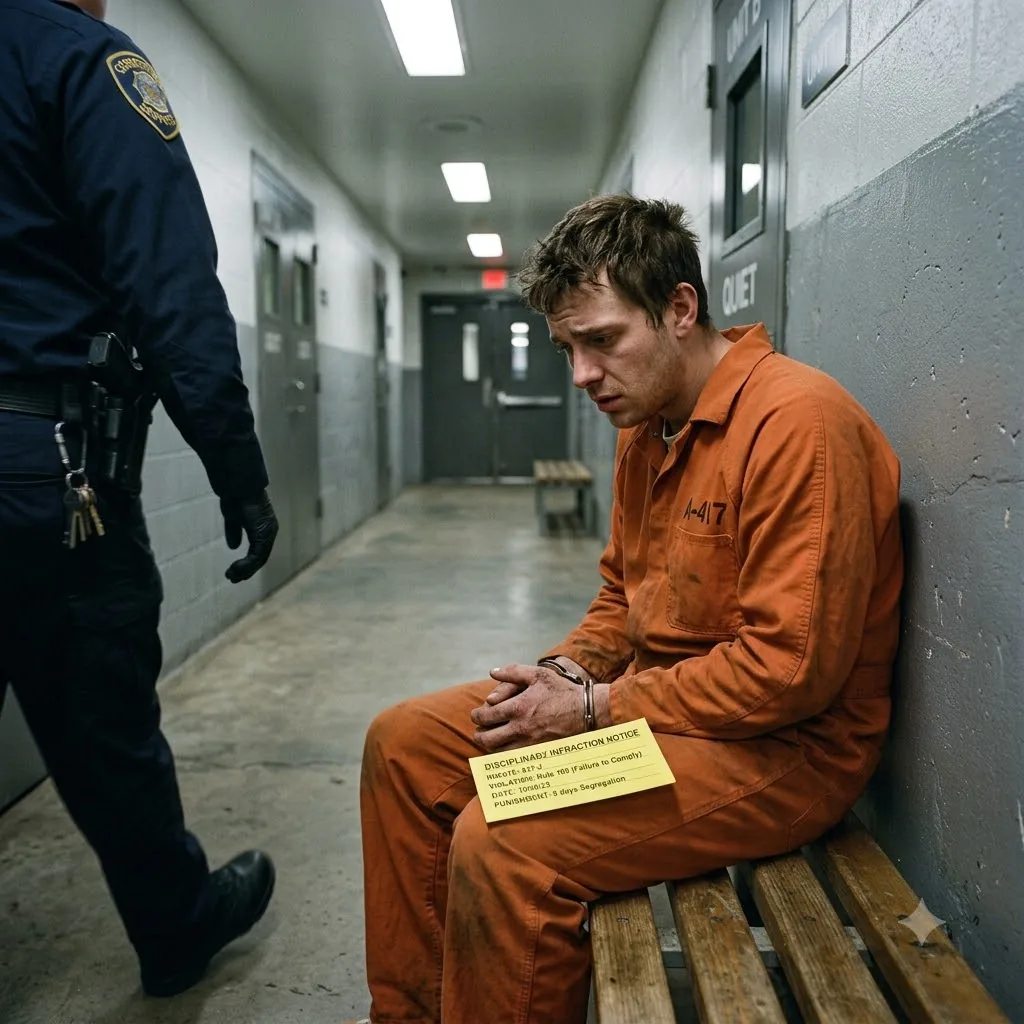
“Option two: Teo signs the yellow slip right now. He accepts the ninety-day freeze in general population. In exchange, I immediately assign him to the Omni-State Logistics warehouse crew here inside the facility. That specific work assignment comes with an administrative signing bonus of five hundred dollars, which I will personally authorize to be paid directly to his primary outside contact. That money will perfectly cover Maria’s loan interest for exactly three months, keeping her vehicle safe. You pack your briefcase and go home. In ninety days, he can try for parole again.”
Sterling stood frozen, his sharp legal arguments rendered suddenly, devastatingly useless against the sheer, crushing weight of the bureaucratic machinery. He looked down at Teo, the aggressive confidence completely drained from his face.
“Teo,” Sterling said softly, kneeling on the scuffed linoleum so they were eye-level. “If you go to the hole, I have to bill for the extra legal visits to fight the transfer. Maria doesn’t have the money. If I walk away today without that bonus… she loses the car by Friday. I can’t stop the bank.”
Warden Vance pulled the cheap plastic pen from Officer Hayes’s hand and held it out toward Teo.
“Sign the paper, Teo,” Vance urged gently. “Take the ninety days. It is the only mathematical way to protect your sister.”
Teo stared at the plastic pen, his chained hands trembling against his knees. The trap was perfectly constructed, locking him in from every possible angle, designed specifically to force him into a corporate labor assignment he had never asked for.