Story code: ST-000962
Part 2: The Ghost in the Machine
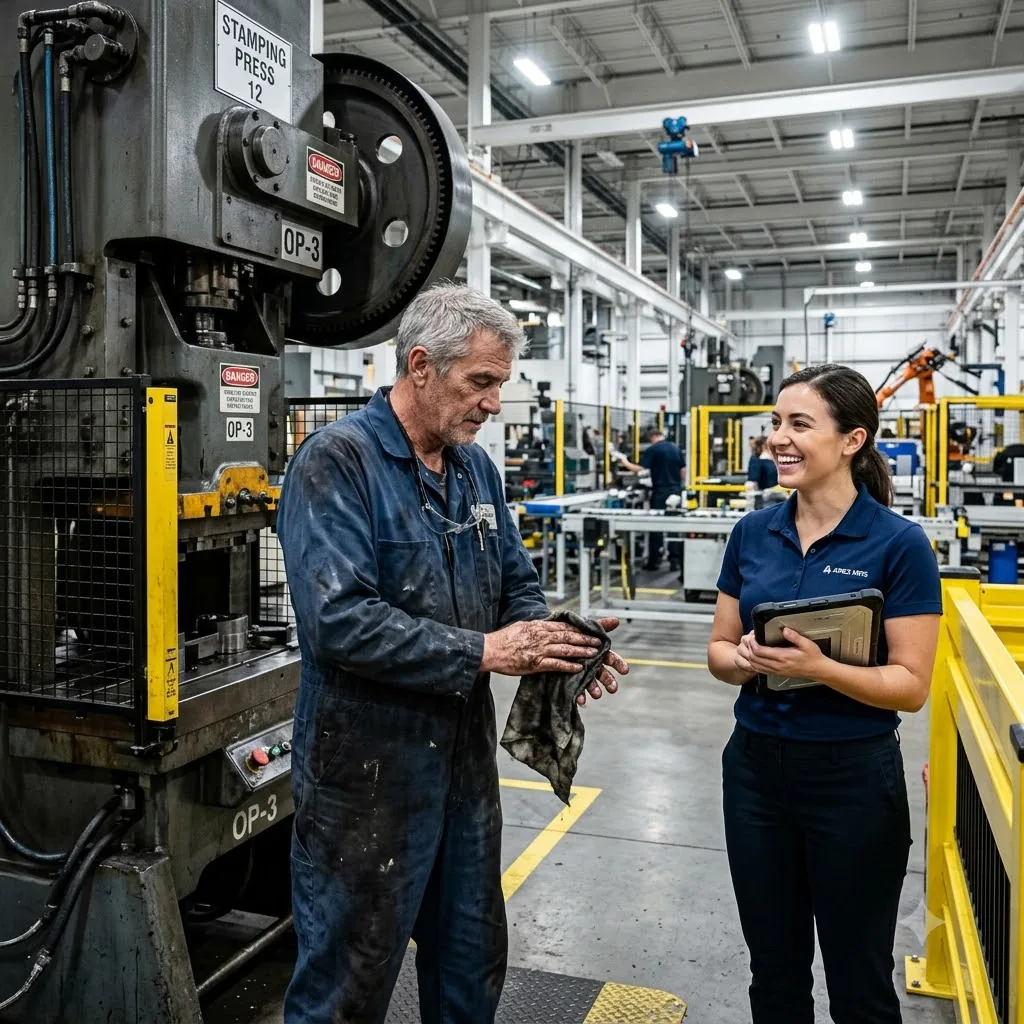
Julian’s pristine boots stopped inches from the yellow safety line painted on the concrete. Artie casually dragged the solvent-soaked rag over the exposed brass plate, leaving a thick smear of gray grease to hide the serial number. He straightened up, his knees popping in protest, just as the plastic box strapped to his ankle let out an audible, high-pitched chirp.
Julian’s smile tightened, the edges of his mouth dropping a fraction of an inch. “Battery hygiene is a core metric of the rehabilitative matrix, Arthur. We discussed this during onboarding.”
“The battery is five years old,” Artie said, keeping his eyes on the hydraulic cylinder. “It doesn’t hold a charge for a full shift anymore. I need fifteen minutes at a wall socket.”
Julian tapped his tablet, shaking his head with a theatrical sigh. “You know the facility protocols. Stationary wall-tethering during operational hours requires a supervisor override, and it automatically drops your daily efficiency rating by twelve percent. That puts you in the red zone for your weekly compliance audit.”
Artie wiped his hands on his jeans. “If it dies, the automated system flags me as a flight risk. The state troopers show up, and I go back inside the wire. I just need to plug it in, Julian.”
“I can’t authorize a stationary tether without penalizing your tier status,” Julian said, his tone dripping with corporate empathy. “However, I can offer a dynamic solution. We have Flex-Charge mobile power banks available for situations exactly like this. It allows you to maintain your cycle times while remaining fully compliant.”
Artie knew there was a catch. There was always a catch in the upskilling ledger. “How much?”
Julian swiped his screen. “It is an ancillary convenience service. Forty-five dollars per use, deducted directly from your pension escrow account. Do I have your verbal authorization to apply the charge?”
Artie’s jaw muscles flexed. Forty-five dollars was roughly what he cleared in three days of work after the mandatory facility housing fees and administrative overhead. He was paying the company to power the shackle the company was forcing him to wear.
The monitor pulsed again, this time vibrating with a frantic double-beat that indicated critical depletion.
“Yeah,” Artie said, his voice perfectly flat. “Authorize it.”
Julian beamed, tapping the screen to finalize the extortion. He unclipped a bulky, rectangular battery pack from his utility belt and handed it over, complete with a short coiled wire. “We are all about keeping you productive, Arthur. Let’s get those cycle times back into the green.”
Artie took the battery pack. It was warm, wrapped in cheap plastic. He bent down, plugged the proprietary connector into the port on his ankle monitor, and shoved the heavy battery into his deep front pocket. The amber light on the cuff switched to a steady, mocking green.
“Back to it,” Julian chirped, already turning his attention to the next station down the line. “Green energy doesn’t sleep!”
Artie turned back to the press. He reached out and touched the cold, chipped yellow paint of the massive iron frame.
It wasn’t just a generic piece of refurbished industrial equipment. The serial number stamped on that brass plate was burned into his memory. Unit 4-A7. He had run this exact press for nine years at the old Dearborn stamping plant before the bankruptcy, before the union was busted, and before the courts decided that his frozen pension was fair game for corporate restitution.
The private contractor hadn’t just upskilled a captive workforce of displaced blue-collar workers. They had bought up the liquidated assets of the old union shops at auction. They shipped the rusted presses, spot welders, and lathes to this non-union facility, painted them bright yellow, and then partnered with the state to force the exact same bankrupt men to operate them for pennies on the dollar.
It was a perfectly closed loop of exploitation.
Artie picked up the next aluminum solar mount and slid it into the jig. He pulled the dual safety levers. The press came down with a deafening crack.
As the heavy iron head retracted, Artie listened. Beneath the hiss of the pneumatics, he heard it: a faint, high-pitched metallic squeal on the upward stroke. A ghost from his past.
Unit 4-A7 had a design flaw in its hydraulic return valve. It was a notorious piece of garbage. If you ran it too fast, the pressure built up unevenly. In the old days, the union safety steward mandated a micro-pause every fifty cycles to let the bleeder valve reset. If you didn’t, the pressure would eventually blow the main seal, dropping two tons of iron without warning.
Artie leaned in closer, his eyes tracing the hydraulic lines. His stomach dropped. The safety interlock-the heavy mechanical catch that was supposed to engage if the hydraulics failed-was gone. It hadn’t just been removed; the mounting brackets had been ground off with an angle grinder. The green-energy contractor had stripped away the old physical fail-safes to shave two seconds off the machine’s return stroke.
Julian’s voice boomed over the facility PA system, cutting through the industrial roar. “Attention floor! We are tracking slightly behind our quarterly throughput targets. Let’s push for a five percent increase in cycle times before the lunch bell! Show me that legacy grit!”
Artie looked down the long line of yellow-painted machinery. Three stations down, he saw Marcus-a man who used to be his shop steward two decades ago-running a heavy brake press. Marcus was staring at his machine, rubbing his chin, looking at a cluster of exposed wiring that shouldn’t have been exposed.
Artie fed another aluminum bracket into the jig. He pulled the levers.
*Crack.*
The squeal on the return stroke was louder this time. The hydraulic housing was growing hot, radiating warmth against Artie’s forearms. He checked the cycle counter on his digital dashboard. He was at forty-eight cycles. Two more, and the pressure in the stripped-down machine would hit the redline.
He had to stop and let the valve bleed. But doing so would trigger a downtime alert on Julian’s tablet, immediately docking his pay further and putting his release timeline in jeopardy. If he kept going, he was playing Russian roulette with two tons of cast iron.
The battery pack in his pocket bumped against his leg, a heavy weight dragging him down.
He fed the forty-ninth piece into the jig.