Story code: ST-000962
Part 4: Captive Iron
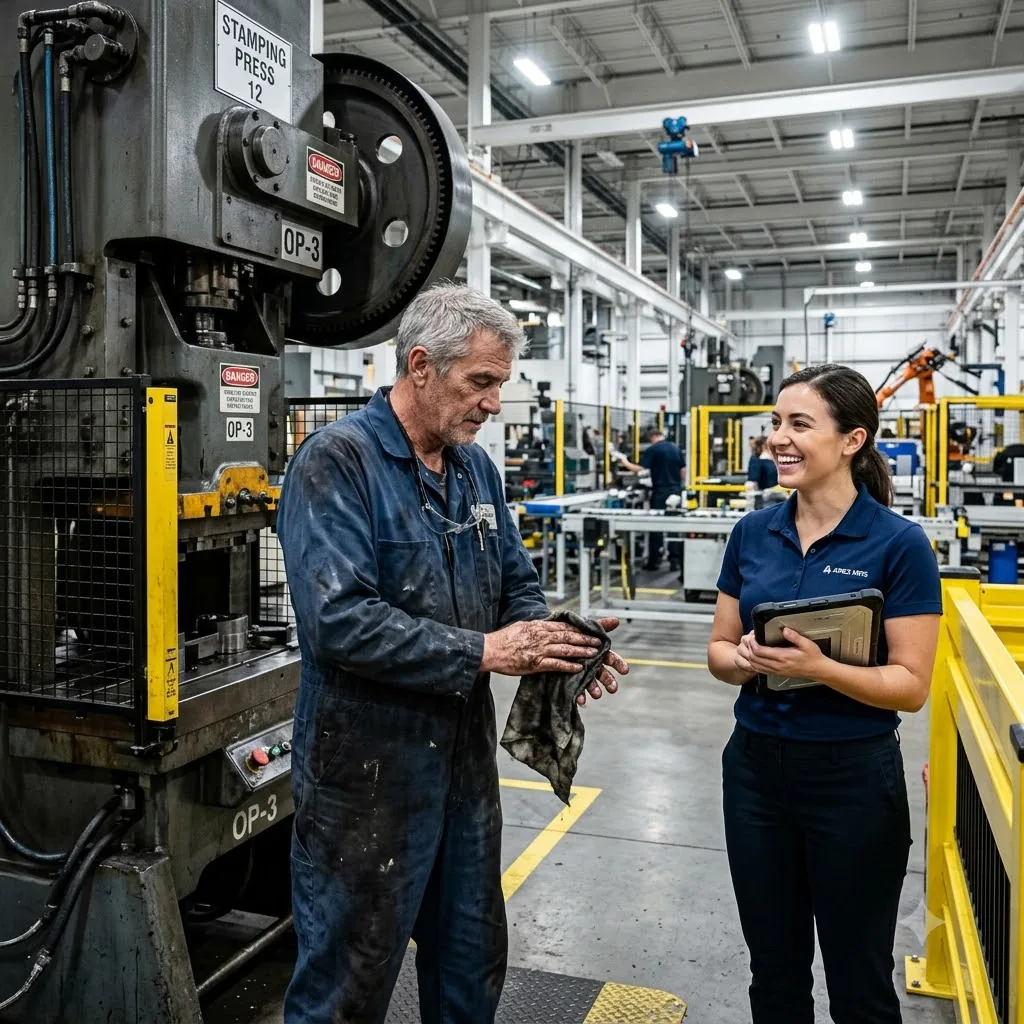
Julian stared at Artie. The tablet in his hands shook slightly, the sleek glass and brushed aluminum vibrating against his palms. The polished corporate vocabulary had completely failed him, leaving only the pale, terrified face of a mid-level manager realizing he was standing on the wrong side of two tons of cast iron and thirty years of suppressed rage.
“You are making a massive mistake,” Julian whispered, his voice entirely stripped of its manufactured PA-system bravado. “I press this button, Arthur, and your restitution agreement is immediately revoked. You go back to county. Today. Right now.”
“Press it,” Artie said, his voice a low, steady rumble.
Julian swallowed hard. His thumb hovered over the screen. His eyes darted from Artie to the dead Toledo press, and back to Artie. He tapped the glass.
Immediately, the overhead LED arrays shifted from daylight white to a strobing, aggressive amber. A synthetic siren began to wail, a harsh, two-tone blast that bounced violently off the corrugated steel ceiling. Automated voices echoed from the PA, calmly instructing all personnel to remain at their workstations and prepare for a mandatory compliance intervention.
But they didn’t remain at their workstations.
Artie watched as the silence rolled down the assembly line like a weather front. It had started with Marcus, whose heavy brake press was already dark. Now, the man next to Marcus-a welder Artie only knew as ‘Big Jim’ from the old chassis plant-reached up and yanked his heavy red electrical disconnect switch.
*Clack.*
Another machine died. The welder stepped back, crossing his thick, tattooed arms, his own bulky plastic ankle monitor blinking uselessly against his work boot.
Further down the aisle, the sound of severed power echoed in a ragged chain reaction. *Clack. Clack. Clack.*
It was a beautiful, devastating sound. The rhythmic, deafening roar of the upskilling facility began to unravel, piece by piece. Men who had been heads-down, desperately chasing ninety-six percent efficiency ratings to pay off imaginary debts, looked up. They saw the flashing amber lights. They saw Artie standing toe-to-toe with the supervisor, the yellow-painted Toledo press completely dead behind him.
One by one, they reached for their own disconnects.
“What are you doing?” Julian yelled, spinning around as the telemetry on his tablet erupted into a sea of red error codes. “Return to operating parameters! This is a localized incident! Station twelve, re-engage!”
Station twelve did not re-engage. The operator, a man with graying temples who walked with a permanent limp from a line accident a decade ago, simply backed away from his lathe and sat down on an overturned plastic bucket.
The silence was total now, save for the wailing siren and the hiss of pneumatic lines bleeding off residual pressure. The massive factory floor, designed to relentlessly extract labor and hide it behind a veneer of green-energy progress, was completely dead. It was a wildcat strike, orchestrated without a single whispered word, born entirely of shared muscle memory and mutual exhaustion. They were captive flesh, strapped to captive iron, but they still knew how to stop the line.
Julian backed away from Artie, his eyes wide, clutching the tablet to his chest as if the slim device could protect him from the fifty men standing motionless in the amber light. He turned and fast-walked toward the glass-walled administrative offices at the far end of the floor, his pristine boots squeaking frantically against the concrete.
Artie let out a long, slow breath. His shoulders dropped.
He reached into his deep front pocket and pulled out the bulky Flex-Charge battery pack. He looked at the coiled wire tethering it to his ankle. Forty-five dollars. A day and a half of sweat, docked straight from a frozen pension he had bled for, just to keep the corporate leash powered.
Artie pinched the proprietary connector and yanked it out of the monitor. He tossed the battery pack onto the metal worktable beside the solvent rag. The cheap plastic casing clattered against the raw steel. Instantly, the ankle cuff registered the power loss, its steady green light dropping back to an angry, flashing amber. It would die in less than two hours.
He didn’t care.
He pulled over a heavy, three-legged metal stool-the kind he used to sit on during his union-authorized breaks back in Dearborn-and sat down beside Unit 4-A7. The iron frame was still radiating intense heat. Deep inside the yellow housing, the faulty return valve finally let go with a prolonged, metallic groan, safely bleeding off the catastrophic pressure that Julian’s digital telemetry couldn’t see.
Marcus walked over, his heavy boots scuffing the concrete. He didn’t say anything at first. He just looked at the exposed brass serial plate on the hydraulic cylinder.
“Unit 4-A7,” Marcus murmured, shaking his head. “I remember when Henderson blew his eardrum on this exact machine back in ’06. Absolute piece of junk.”
“They ground off the mechanical drop-catch with an angle grinder,” Artie said quietly.
Marcus leaned in, squinting at the scarred raw steel where the safety interlock used to be. He let out a low whistle, a sound entirely devoid of surprise. “Course they did. Can’t have the meat slowing down the machine.”
The heavy steel bay doors at the front of the facility began to rattle. Through the reinforced glass of the loading dock, Artie could see the flashing red and blue lights of the county sheriff’s cruisers pulling into the loading zone. Julian had hit the panic button, exactly as promised. The state was here to collect its defective property.
“You’re going back inside the wire, Artie,” Marcus said, keeping his eyes on the approaching flashing lights.
“I know,” Artie said.
“They’re going to liquidate your escrow. You’ll lose whatever money you put into this place.”
“I didn’t have anything to begin with,” Artie replied, resting his hands on his knees. They were stained deep into the creases with black grease and industrial solvent. They were the hands of a machinist.
Outside, heavy fists pounded on the pedestrian door. Julian was running across the floor to let the deputies in.
Artie leaned his head back against the warm iron of the dead press. The siren wailed above them, but on the floor, the men remained completely silent, standing as a united front of motionless gray jumpsuits. For the first time since the bankruptcy, since the judge banged the gavel, since the plastic shackle was locked around his leg, Artie felt a deep, profound stillness in his chest. He was a prisoner, but he was no longer a prop. He closed his eyes and waited for the heavy boots to reach him.