Story code: ST-000962
Part 3: Section 14
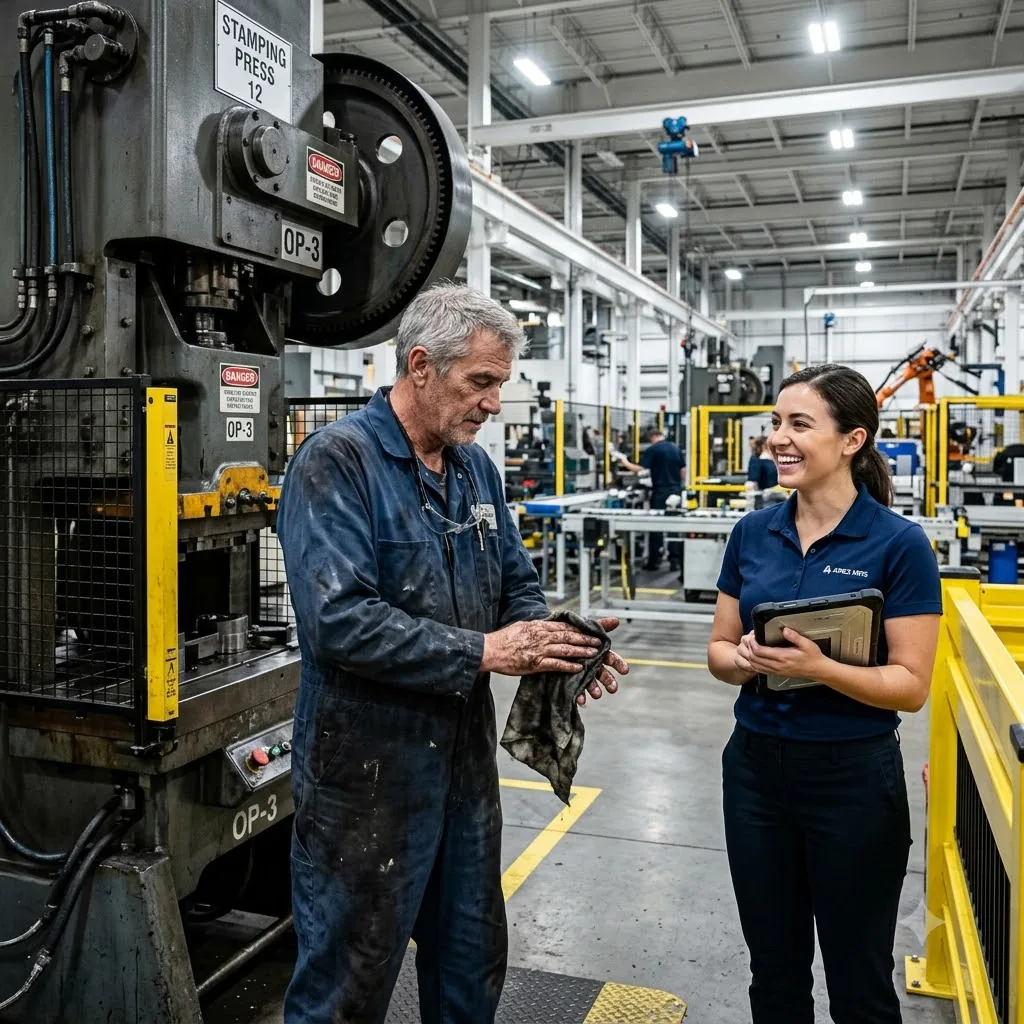
The aluminum bracket went into the jig. Artie’s calloused hands gripped the dual safety levers. He didn’t just pull them; he braced his shoulders against the frame.
*Crack.*
The hydraulic whine pitched upward into a ragged scream that rattled his teeth. The cast-iron housing shuddered, throwing off a fine mist of vaporized machine oil. The cycle counter on the digital dashboard blinked to forty-nine.
Heat radiated off the primary cylinder, baking the sweat onto Artie’s forearms. He could smell the hydraulic fluid beginning to scorch, a sharp, bitter scent that transported him straight back to 1998. Back then, they called it the “breather.” The union shop steward used to walk the line with a stopwatch. If you hit fifty continuous cycles on a Toledo 400-ton straight-side press, you backed off. You let the pressure bleed. If you didn’t, the return valve bottlenecked, and the main seal ruptured. Without a safety interlock, two tons of cast iron would drop in freefall. A guillotine for anyone standing too close.
Julian’s voice buzzed through the facility PA system, excessively cheerful and aggressively loud. “Station four, you are showing a micro-idle! Keep the rhythm, Arthur! The dashboard needs you in the green!”
Artie looked at the blinking screen. He looked down at the bright yellow paint chipping away to reveal the old brass plate. Finally, he looked at his own leg. The ankle monitor pulsed a steady, mocking green, feeding off the forty-five-dollar charge he had just paid to the company store.
The entire racket clicked into place with horrifying clarity.
This wasn’t a green-energy revolution. This startup was a scavenger operation. They had bought the shuttered union plants at bankruptcy auctions-the rusted presses, the die cutters, the lathes. They shipped the heavy iron out here, painted it yellow, and ground off the safety catches to squeeze out two more seconds of productivity.
But the machines weren’t enough. They needed the operators. They needed the specific, deeply ingrained muscle memory of the men who used to run them. So they partnered with the courts. They used restitution laws to herd the displaced, bankrupt men of the rust belt back onto the line, shackling them with GPS monitors and arbitrary debt. Captive iron. Captive flesh. They had bought the whole ecosystem for pennies on the dollar.
“Station four, I am seeing a red-line delay!” Julian’s voice snapped, losing its manufactured warmth. “Arthur, engage the press!”
Artie took a breath. He pulled his hands away from the dual levers. He took a deliberate step backward, out of the operating zone.
Mounted on the steel column beside the press was the main electrical disconnect. A heavy, red rotary switch designed to cut all 480 volts of three-phase power to the machine.
Artie reached up, grabbed the heavy plastic handle, and yanked it down.
The heavy contacts severed with a sound like a gunshot. The press let out a long, dying sigh as the air lines bled their residual pressure. The digital tablet mounted to the jig instantly went black. The overhead status light snapped from green to a harsh, strobing crimson.
Down the line, the rhythmic slamming of metal faltered. Marcus looked up from his brake press. Two other men in gray jumpsuits stopped feeding their machines, turning to stare at the flashing red light.
“Arthur!” Julian didn’t bother with the PA system this time. He was power-walking down the center aisle, his spotless high-visibility vest flapping, his tablet raised in front of him like a weapon. “What in God’s name are you doing? You just triggered a hard power fault! You are tanking your entire sector’s rolling average!”
Artie stood perfectly still. He reached into his pocket, his fingers wrapping around the warm bulk of the battery pack. “The return valve is failing. It needs to bleed out the pressure.”
Julian stopped at the yellow safety line, jabbing a manicured finger at his screen. “My diagnostic telemetry shows nominal pressure. The machine is completely fine. Turn it back on. Right now. This is a direct refusal of work.”
“Your telemetry is reading the intake cylinder, not the return,” Artie said, his voice a low, gravelly rumble that carried easily over the slowing machinery around them. “The return is bottlenecking. One more cycle and it blows the seal.”
Julian scoffed, taking a step over the yellow line, invading Artie’s workspace. “You are a court-mandated trainee, Arthur. You do not diagnose proprietary upskilling hardware. You pull the levers. Now re-engage the power before I flag you for a parole violation. I will have the state troopers here in ten minutes to escort you back to a holding cell, and your pension escrow will be fully liquidated for breach of contract.”
Artie looked at the young manager. He looked at the smooth, uncalloused hands, the uncreased vest, the absolute arrogance of a man who only understood reality through a user interface.
“It’s not proprietary,” Artie said. He picked up the solvent-soaked rag and threw it onto the metal work table. “It’s a Toledo 400-ton straight-side press. Manufactured in 1992. I ran it for nine years at the Dearborn stamping plant.”
Julian’s finger froze over his tablet. He blinked, the corporate mask slipping for a fraction of a second. “What?”
“You bought our bankrupt plant’s liquidated hardware at auction,” Artie said, taking a slow, heavy step toward Julian. “You shipped it here. You painted it yellow. And then you contracted the state to lease you the exact same men you put out of work, just so you could run it non-union, without the stops.”
“That is an absurd fabrication,” Julian stammered, his voice climbing an octave. His eyes darted nervously toward the exposed brass serial plate on the hydraulic housing. “This facility is LEED certified…”
“Serial number 4-A7,” Artie interrupted, his voice rising, bouncing off the concrete walls.
Down the aisle, Marcus reached out and killed the power to his own brake press. The silence began to spread down the line, a localized contagion of dead machinery.
“It has a known, documented defect in the hydraulic return,” Artie continued. “You have to pause every fifty cycles.”
“Turn it on!” Julian demanded, his face flushing red. “I am logging a Category One non-compliance!”
“Log it,” Artie said. He pointed a thick, grease-stained finger at the side of the massive iron housing. “Look right there. The raw steel under the yellow paint. Somebody took an angle grinder to the mechanical safety interlock. You cut off the physical drop-catch so you could shave two seconds off the cycle time.”
Julian swallowed hard, his throat working. “That… that was an unauthorized modification by the refurbishment vendor. It doesn’t matter. You are refusing a direct order.”
“I’m invoking Section 14, Article 8 of the United Auto Workers safety bylaws,” Artie said, crossing his arms over his chest, his boots planted firmly on the concrete. “Right to refuse work under condition of imminent bodily harm.”
Julian let out a sharp, breathless laugh. “Are you insane? You don’t have a union, Arthur. You are a ward of this facility. The UAW doesn’t exist here. You have no rights to invoke!”
“The union is gone,” Artie agreed, his eyes locking onto Julian’s with a cold, heavy certainty. “But the federal OSHA grandfather clause for legacy heavy machinery mandates that all original manufacturer and union-negotiated safety interlocks remain intact. If they are removed, the machine is legally condemned.”
Julian’s tablet lowered an inch. His mouth opened, but no words came out.
“So go ahead,” Artie said softly, the silence of his dead machine now an oppressive weight between them. “Hit your compliance alarm. Call the state troopers. Tell them to bring a federal safety inspector with them when they come. Let’s see who goes inside the wire.”