Story code: ST-001252
Part 2: The Locked File
“Gasoline,” Miller said. The word was a heavy stone dropped into the hollow space of Marka’s earpiece. “The fumes are already hitting the HVAC intakes. The lobby smells like a refinery.”
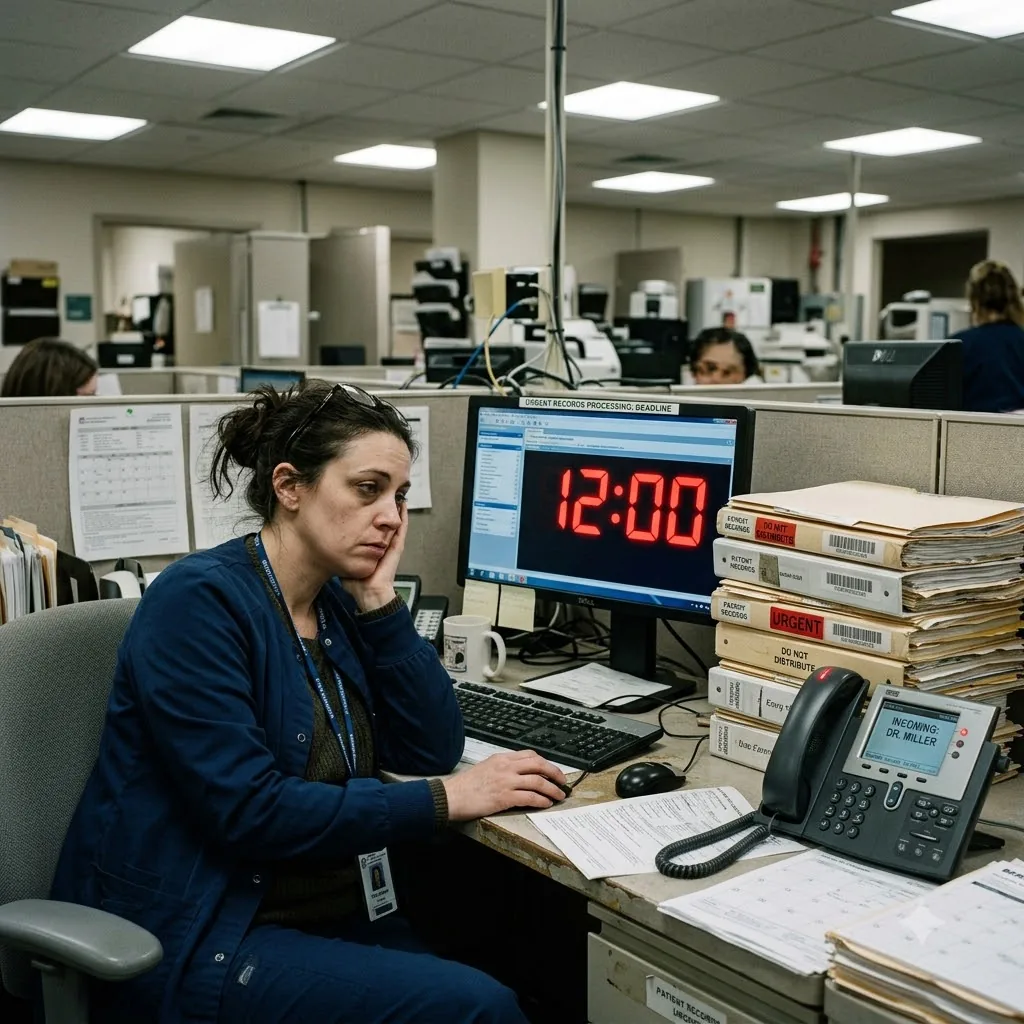
Marka’s eyes darted to the top right of her screen. The timer for Claim 8895-Bravo showed 07:12. The red digits pulsed, completely indifferent to the reality unfolding downstairs.
“What does he want?” Marka asked, her voice dropping to a whisper.
“He isn’t speaking,” Miller said. “He just keeps pointing at the bottom of the denial letter. At your employee ID. And he’s holding his phone up to the glass. It’s displaying a phone number. He wants you to call him.”
Before Marka could process the instruction, a shadow fell over her desk.
Todd, the section supervisor, leaned over her low gray fabric partition. He wore a crisp, pastel blue polo shirt and carried a company-issued tablet. His brow was furrowed in an expression of manufactured corporate disappointment.
“Marka,” Todd said, tapping a stylus against the edge of her cubicle. “You’ve been parked on 8895-Bravo for six minutes. Your idle status is dragging down the pod’s rolling average. If you need a personal moment, you need to toggle to ‘Break’ so the algorithm pauses your metrics.”
Marka stared at him, the heavy receiver still pressed to her ear. She covered the mouthpiece. “Todd, we have a security situation. The lobby is breached.”
Todd frowned, looking around the expansive, humming bullpen. Forty other adjusters continued their relentless, rhythmic clicking. The low murmur of white noise generators pumped through the ceiling speakers. “I haven’t received an email from Facilities,” Todd said, his tone dripping with patronizing patience. “Until an official alert goes out, the floor is active. You need to clear this file.”
“Miller,” Marka said into the receiver, ignoring her supervisor. “Can you read the claim number off the letter he’s holding?”
“Hang on,” Miller muttered. The sound of radio static hissed in the background. “It’s smeared with something, but it looks like 4421-Echo.”
Todd huffed, reaching over her shoulder to point at her screen. “Marka, you are severely out of protocol. If you don’t release 8895-Bravo right now, I’m initiating a formal write-up.”
“Do it,” Marka said, her voice shaking with sudden, sharp adrenaline. She grabbed her mouse and clicked ‘Suspend’ on her current file. The timer vanished, replaced instantly by a glaring yellow warning banner: *METRIC PENALTY APPLIED.*
Todd gasped softly at the insubordination, his stylus freezing in mid-air.
Marka opened the master database archive. The legacy software was notoriously sluggish, the screen freezing for several agonizing seconds before producing a blinking search bar. She typed in *4421-Echo* and hit enter. A blue loading circle spun in the center of her monitor.
“He’s moving,” Miller said, his voice tightening. “He just reached into the duffel bag. He pulled out a red tube. Marka, it’s a road flare. He’s holding a road flare and a striker.”
“I’m pulling the file,” Marka said, her palm sweating against the plastic shell of the mouse.
The database finally refreshed. The file populated on her left monitor.
*Veteran Name: Elias Thorne.*
*Location: Columbus, Ohio.*
*Claim Type: Out-of-network surgical intervention and extended pain management.*
*Adjudicator ID: 68423 (Marka).*
*Decision Date: October 14th.*
*Status: Denial – Code 4 (Deficient Documentation).*
Marka stared at the date. Six weeks ago. Just another Tuesday. Just another file in a blur of hundreds she had processed that week to hit her ninety-five percent clearance rate.
She scrolled down to the appended notes at the bottom of the digital file. The text was highlighted in stark black and white, an automatic update from the federal death registry.
*Update: November 2nd. Veteran deceased. Cause of death: Self-inflicted gunshot wound. File locked. Benefits terminated.*
A cold knot formed in Marka’s stomach. She looked at the emergency contact listed right above the death notice. *David Thorne. Brother.*
“Miller,” Marka said, her mouth bone-dry. “The man in the lobby. Is he wearing a blue jacket with a local union patch on the shoulder?”
“Yeah,” Miller replied, sounding surprised. “How did you know?”
“He’s the brother of a veteran whose claim I denied last month. The veteran killed himself two weeks later.”
Todd, who had been reading over her shoulder, suddenly took a step back. The color drained from his face, leaving his pastel polo looking entirely out of place. “Oh my god,” he whispered. “You accessed a deceased file without a regional director’s permission.”
Marka ignored the absurd, misplaced bureaucratic panic. “Miller, read me the phone number he’s holding up.”
Miller rattled off a ten-digit number. Marka typed it into her desktop softphone client. She put on her headset, switching the audio away from the heavy plastic receiver. She clicked the green ‘Dial’ icon.
The line rang once.
“Hello,” a flat, hollow voice answered.
“Mr. Thorne,” Marka said, trying to keep her breathing steady. “This is Marka. My ID number is 68423.”
“You’re the one,” David Thorne said. There was no rage in his voice, only a terrifying, empty calm. “You clicked the button.”
“I did,” Marka said, refusing to offer a corporate platitude. “I processed the file.”
“Elias lost his house because of that letter,” David said. The faint echo of the lobby’s acoustics bled through the connection. “His wife moved into a motel with their daughters. Then he shot himself in his truck. The VA says they won’t pay out the survivor benefits because he was under a pending fraud investigation for trying to get his meds outside the network. Because of your denial.”
Above Marka’s desk, the ceiling-mounted emergency strobe lights began to flash in a silent, blinding sequence of bright white bursts. The building had entered a stage-one lockdown. The soft click of the magnetic locks sealing the stairwells echoed across the claims floor. Murmurs of panic finally began to ripple through the bullpen as adjusters realized they were trapped.
“Mr. Thorne, please,” Marka said. “Do not light the flare. I am listening to you.”
“I don’t want you to listen,” David replied. “I want you to fix it. I have the VA claims portal open on my phone right now. You are going to go into Elias’s file. You are going to reverse the Code 4 denial. You are going to approve the out-of-network coverage retroactively, which clears the fraud flag, which releases the survivor benefits to his wife.”
“Tell him yes,” Todd hissed in her ear, leaning in close, his corporate bravado entirely shattered. “Just tell him you did it!”
“I have the app open,” David repeated, his voice dropping an octave. “I will refresh it in exactly three minutes. If the status doesn’t change from ‘Denied’ to ‘Approved’, I strike the flare. Do not lie to me. I will see it on the screen.”
Marka stared at her left monitor. She moved her cursor over the drop-down menu labeled ‘Claim Status’.
The box was gray.
Because the registry had logged Elias Thorne as deceased, the system had automatically locked the entire file. Standard adjusters were strictly stripped of write-access to prevent posthumous fraud. The only way to unlock a dead veteran’s file was to submit a Form 99-Delta to the regional director in Chicago, a process that typically took four to six months.
Marka clicked the gray box. Nothing happened. The software emitted a dull, flat error chime in her headset.
She clicked it again. Harder. The error chime repeated.
“Mr. Thorne,” Marka said, her voice finally trembling. “The system… the system won’t let me.”
“Two minutes and forty seconds,” David said, and the line went dead.