Story code: ST-001252
Part 3: The Script
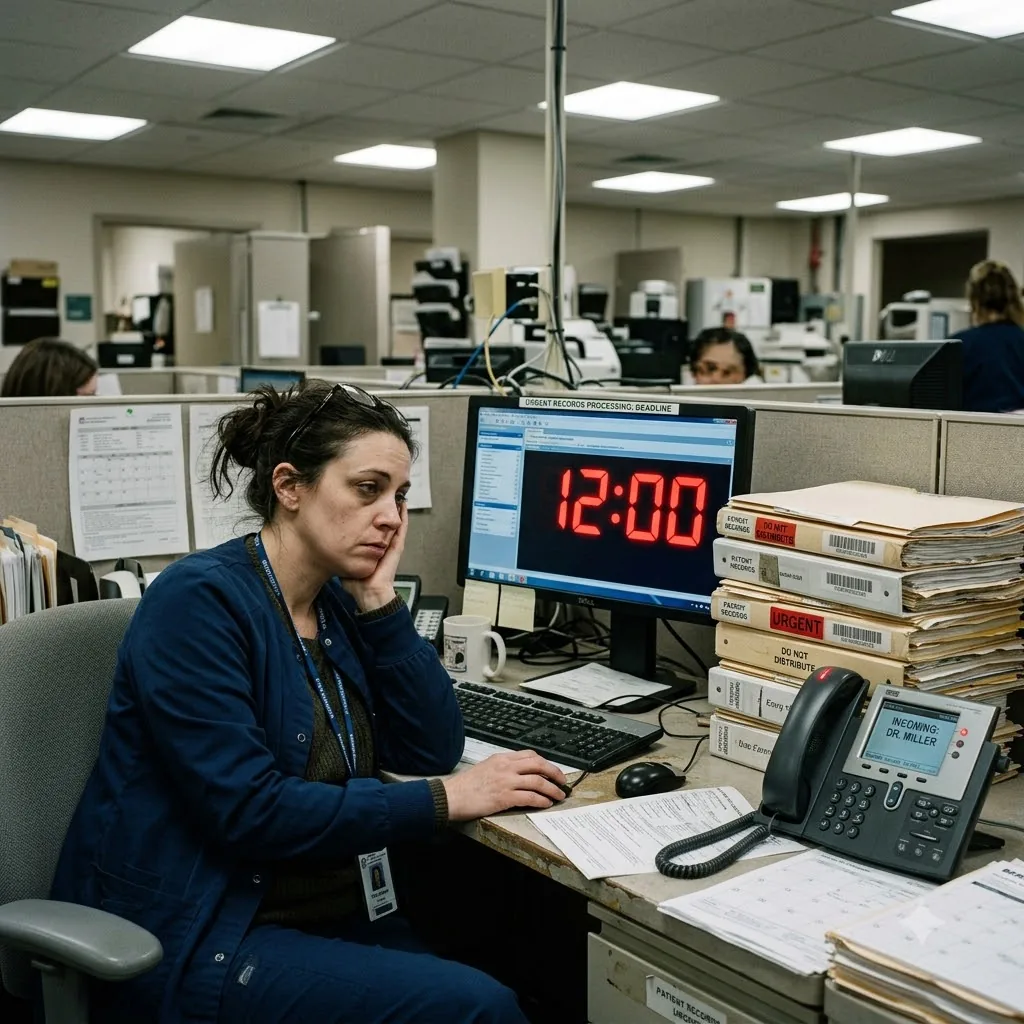
Marka hammered the left mouse button. The cursor hovered over the grayed-out ‘Claim Status’ field. *Chime. Chime. Chime.* The legacy system’s flat error sound, usually a dull background annoyance, now felt like a hammer striking an anvil inside her headset.
Todd was hyperventilating, his hands planted flat on Marka’s desk, his pastel polo shirt darkening with sweat at the collar. “Call the Omaha center,” he gasped, his eyes darting toward the flashing ceiling strobes. “Tell them to route an emergency ticket to the database admins. Tell them to force an override.”
“The admins are in Bangalore,” Marka said, her voice eerily detached as the adrenaline peaked and leveled off into cold clarity. “They require a Form 99-Delta signed in wet ink by a regional director to unlock a deceased file. The database is hard-coded. It is physically impossible for me to change this status.”
“You have to do something!” Todd hissed, his voice cracking. He pointed a trembling finger at her right monitor. “Open the de-escalation protocol! Read the script!”
Marka opened a new tab on her secondary screen and brought up the corporate intranet. She navigated to the emergency HR directory and clicked on ‘Hostile Claimant Protocol.’ A PDF loaded, filled with bullet points in a soothing, corporate blue font.
*Step 1: Validate the claimant’s emotional state.*
*Step 2: Use active listening markers (‘I hear that you are upset’).*
*Step 3: Assure the claimant that their file is a priority.*
She looked at the digital clock on her dashboard. 01:52. One minute and fifty-two seconds until David Thorne struck the flare in a lobby full of gasoline fumes.
Marka clicked the redial icon on her softphone client. The line hissed with static before connecting. The background noise of the lobby-the low hum of the HVAC, the distant wail of police sirens approaching the building-bled through the headset.
“One minute, forty-five seconds,” David’s flat, hollow voice stated. “I just dragged my thumb down the screen. It refreshed. The status still says ‘Denied’.”
Marka took a breath and looked at the PDF. “Mr. Thorne, I hear that you are upset,” she read, her voice tight and unnatural. “Please know that your brother’s file is my top priority right now, and I am actively working with my supervisor to review his case and expedite a solution.”
A heavy silence stretched over the line, broken only by the sharp, rhythmic *clack* of David striking the plastic cap of the road flare against the side of his leg.
“You’re reading to me,” David said. The terrifying calm in his voice fractured, revealing a razor-thin edge of disgust. “He bled out in a Ford Ranger because of you, and you’re reading a script. You looked at a man with shrapnel in his spine, a man who gave his legs to this country, and you decided he was a fraud. You judged him.”
“Mr. Thorne, we are looking for a way-”
“You looked at his file and you judged him!” David yelled, the sudden volume making Marka wince, the audio peaking in her earpiece. “You saw him struggling and you chose to ruin him! Why? Did you think he was a junkie? Did you think he was weak?”
Marka stared at the PDF. *Step 4: Pivot the conversation away from blame.*
She looked past the monitor, out into the sprawling bullpen. Forty adjusters were huddled under their desks or pressed against the far wall, trapped by the magnetic locks on the fire doors. The silent white strobe lights washed over the gray fabric of the cubicles, rendering the room in stark, flashing snapshots of bureaucratic terror.
She looked down at her aching right wrist, the joint swollen and throbbing from thousands of identical, meaningless clicks.
“No,” Marka said.
She reached up and closed the HR manual tab.
“What?” David asked, breathing heavily. “One minute, twenty seconds. I have the striker in my hand.”
“I didn’t judge him,” Marka said, her voice dropping the customer-service cadence entirely. “I didn’t think he was a junkie. I didn’t think he was weak.”
Todd frantically waved his hands, shaking his head, mouthing the word *Stop.*
Marka ignored him. “I didn’t think anything about your brother, Mr. Thorne. Because I didn’t read his file.”
The line went entirely still. Even the background rustling stopped. “You’re lying,” David whispered. “You put your ID number on the letter.”
“I’m an Adjudicator Level 2,” Marka said, staring blankly at the locked database screen. “Management gives me a daily quota. To meet that quota, I have exactly twelve minutes to process each claim. Your brother’s file was three hundred and fourteen pages long. It was filled with handwritten field hospital notes and complex surgical histories from Kandahar.”
“You denied it,” David said, his voice faltering, losing its furious momentum.
“I opened the file,” Marka continued, the words spilling out with brutal, sterile precision. “I typed ‘Form 21-4138’ into the document index. The system requires that specific form to authorize out-of-network pain management. The search returned zero results. Finding a medical substitute in his field notes would have taken me twenty, maybe thirty minutes of reading.”
“So you just…”
“If I take thirty minutes on a file, my rolling average drops. If my average drops below ninety-five percent, I receive a formal warning. Three warnings, and I am terminated. So, at the forty-five-second mark, I clicked a red box labeled ‘Deficient Documentation’.”
Marka leaned forward, her eyes locked on Elias Thorne’s name on the grayed-out screen. She was no longer speaking to de-escalate. She was confessing to the machine she had become.
“I didn’t look at his photo. I didn’t read about his shrapnel. I clicked the red box, I selected ‘Code 4’, and the software automatically generated the denial letter you are holding. Then it stamped my ID on it, and it mailed it.”
“You couldn’t take ten more minutes?” David’s voice was barely a rasp. “For a man’s life?”
“The system is not designed to evaluate a man’s life,” Marka said, the cold truth echoing in the headset. “It is designed to clear the backlog. The algorithm incentivizes denial because approvals require secondary verification, which takes too much time. If I approve complex claims, I miss my quota. The system pays me to say no, as fast as possible.”
The strobe lights continued their silent, blinding pulses across the ceiling.
“I can’t unlock the file, David,” Marka said. “Because he’s dead, the database is sealed to prevent posthumous fraud. I can’t click the box. I can’t reverse it. There is no button that fixes this. You brought gasoline and a flare to fight a ghost in a machine.”
The timer on Marka’s dashboard, suspended in yellow, sat frozen on the screen. On the other end of the line, there was only the hollow, echoing silence of the lobby. The rhythmic tapping of the road flare against David’s leg had stopped. The script was gone. The three minutes were up, and all that remained was the crushing, mechanical truth.