Story code: ST-001170
Part 1: The Open Line
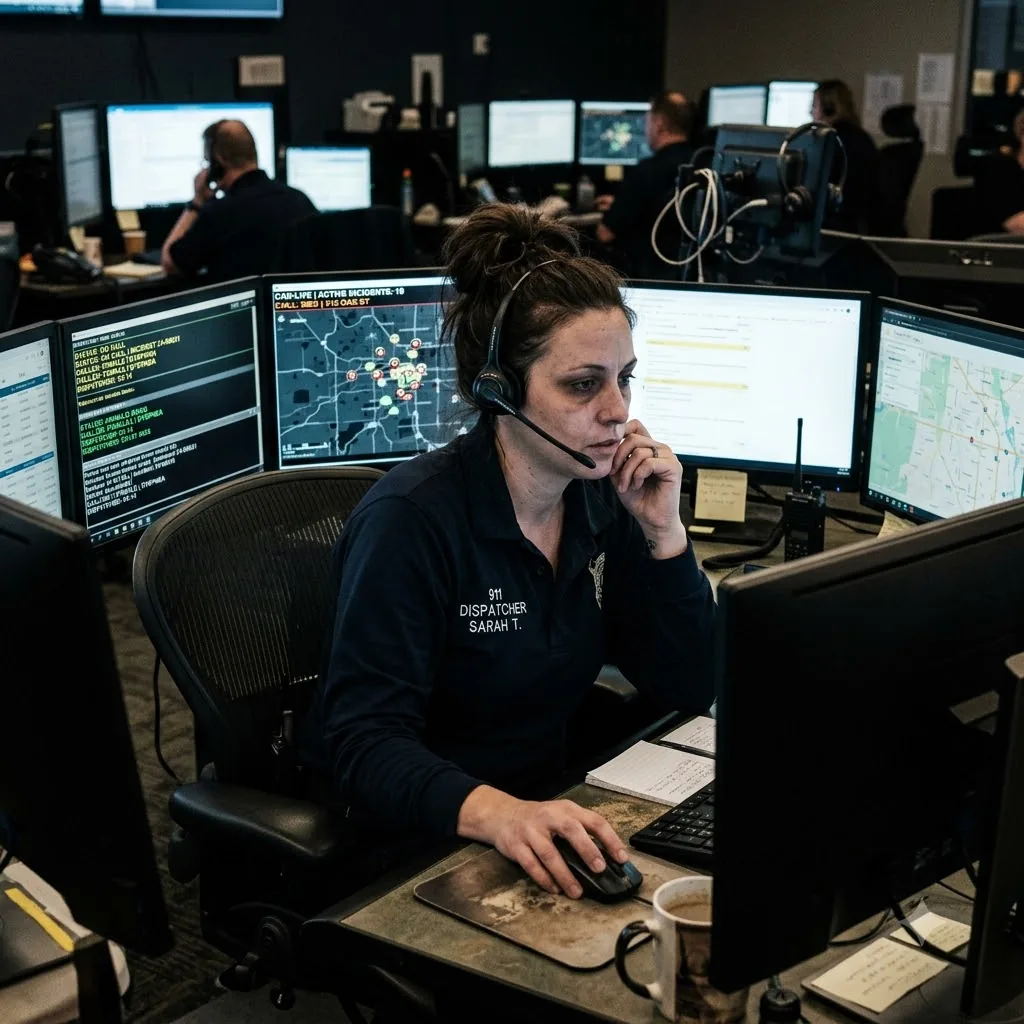
The foam pads of my headset seal me inside a dark, compressed world of audio, completely severing me from the physical reality of the room. I cannot hear the fluorescent lights buzzing overhead, nor the murmur of fifty other dispatchers working the graveyard shift around me. My entire existence is narrowed down to the sterile glow of my dual monitors and the static-laced breathing pouring directly into my ears. On my right screen, the Computer-Aided Dispatch interface blinks with perfectly uniform white text against a black void. The digital readout displays a name and address I have already typed twice since I clocked in. Brenda Vance is on the non-emergency line again, her breath hitching in a jagged, uneven rhythm that spikes the green decibel meter hovering at the bottom of my display.
I log her caller ID, my fingers moving entirely on muscle memory after fourteen exhausting hours in this ergonomic chair. The air conditioning in the center is permanently set to a frigid temperature to keep the server racks cool, but a thin, uncomfortable layer of sweat currently coats my palms.
“He is back,” Brenda whispers, the microphone of her cell phone brushing aggressively against some kind of heavy fabric. “The same unmarked gray van from this afternoon. I told you they would return.”
I pull up the previous incident logs for her sector. Call one, received at three in the afternoon, involved a mail carrier taking a shortcut across her lawn. Call two, logged just after dusk, was a lost teenager trying to fix a dropped bicycle chain under a streetlight. I press the transmit pedal under my desk, keeping my voice utterly devoid of emotion.
“Dispatch receives, Mrs. Vance. Please remain inside your home and make sure your doors are locked.”
“You do not understand the severity of this situation,” she hisses. Her voice drops an entire octave. It sheds the frantic, flighty energy of her earlier calls and settles into a cold, terrifying certainty. “He is looking at the Adams house across the street. He has a cardboard package in his hands, but there is no corporate logo on his shirt. They are sending people to map the perimeter.”
I watch the digital timer on the active call log tick upward, counting the seconds I am wasting. The operational protocol for chronic nuisance callers dictates a firm redirection followed by a swift termination of the call. We must keep the non-emergency lines clear for actual public assists. I sit up straighter, trying to stretch a hard knot of tension out of my lower back. I apply the practiced cadence designed to de-escalate civilian paranoia.
“Delivery drivers often use personal vehicles during peak seasons, Mrs. Vance. Many are independent contractors without uniforms. Unless this individual is actively attempting to breach a residence, there is no dispatchable offense occurring. Do not approach the individual under any circumstances.”
“The neighborhood watch warned us about this specific tactic,” Brenda mutters, completely ignoring my instructions. The audio feed picks up the heavy, metallic sound of a deadbolt clicking open. “They told us the city police would be too slow to respond. They told us we had to secure our own borders.”
I type rapidly, logging her statements verbatim into the CAD narrative field. Caller exhibiting elevated paranoia. Advised to stay indoors. Caller refusing directives. I need to get her off the line. I have an entire queue of actual emergencies stacking up on the board, indicated by a relentless column of flashing red icons on my left monitor. I press the floor pedal again.
“Mrs. Vance, I am terminating this call now. I will document your report in the system, but you must remain inside.”
“He is stepping onto the porch,” she says. Her breathing is loud, wet, and right against the receiver. The distinct squeak of a screen door hinge forces its way through the static. She is outside. She has deliberately left the safety of her house.
“Return to your interior space immediately,” I command, leaning my mouth closer to the microphone boom. “Do not engage the driver.”
“I am not going to let them take our streets.”
Her words are chilling. The terror does not come from the paranoia itself, but from the utter, flat deadness in her delivery. She sounds entirely resigned to a violent outcome.
Then comes the sound.
It cuts sharply through the background noise of the suburban night, mechanical and heavy. It carries a distinct resonance that I have been trained to identify in a fraction of a second through hours of academy audio drills.
Clack-clack.
It is the unmistakable sound of a slide racking on a semi-automatic handgun. The metallic snap echoes across the open line, instantly freezing my hands hovering above the keyboard. My screen still reads Non-Emergency Public Assist, a mundane categorization that is now disastrously incorrect. Protocol dictates I press the transfer button, move the call to the emergency queue, and wait for an available police dispatcher to pick up the line. That transfer process takes at least forty seconds on a busy Friday night. Forty seconds is enough time for an innocent delivery driver to bleed out on a manicured suburban lawn.
I rip my headset cord entirely out of the console socket. I reach across my desk and grab the emergency override handset, a bright red receiver that directly interrupts the live radio traffic of the patrol units in sector four. This is a severe, fireable violation of the center’s operational boundaries. Dispatchers do not jump queues, and we never broadcast over live pursuit channels without explicit supervisor authorization. My floor manager is already waving frantically at me from the glass booth, her face twisting into a mask of outrage as she sees the red override light illuminate above my station.
I ignore her completely. I grip the heavy plastic receiver as the channel opens with a loud burst of squelch, pressing the talk button down hard.
The foam pads of my headset seal me inside a dark, compressed world of audio, completely severing me from the physical reality of the room. I cannot hear the fluorescent lights buzzing overhead, nor the murmur of fifty other dispatchers working the graveyard shift around me. My entire existence is narrowed down to the sterile glow of my dual monitors and the static-laced breathing pouring directly into my ears. On my right screen, the Computer-Aided Dispatch interface blinks with perfectly uniform white text against a black void. The digital readout displays a name and address I have already typed twice since I clocked in. Brenda Vance is on the non-emergency line again, her breath hitching in a jagged, uneven rhythm that spikes the green decibel meter hovering at the bottom of my display.
I log her caller ID, my fingers moving entirely on muscle memory after fourteen exhausting hours in this ergonomic chair. The air conditioning in the center is permanently set to a frigid temperature to keep the server racks cool, but a thin, uncomfortable layer of sweat currently coats my palms.
“He is back,” Brenda whispers, the microphone of her cell phone brushing aggressively against some kind of heavy fabric. “The same unmarked gray van from this afternoon. I told you they would return.”
I pull up the previous incident logs for her sector. Call one, received at three in the afternoon, involved a mail carrier taking a shortcut across her lawn. Call two, logged just after dusk, was a lost teenager trying to fix a dropped bicycle chain under a streetlight. I press the transmit pedal under my desk, keeping my voice utterly devoid of emotion.
“Dispatch receives, Mrs. Vance. Please remain inside your home and make sure your doors are locked.”
“You do not understand the severity of this situation,” she hisses. Her voice drops an entire octave. It sheds the frantic, flighty energy of her earlier calls and settles into a cold, terrifying certainty. “He is looking at the Adams house across the street. He has a cardboard package in his hands, but there is no corporate logo on his shirt. They are sending people to map the perimeter.”
I watch the digital timer on the active call log tick upward, counting the seconds I am wasting. The operational protocol for chronic nuisance callers dictates a firm redirection followed by a swift termination of the call. We must keep the non-emergency lines clear for actual public assists. I sit up straighter, trying to stretch a hard knot of tension out of my lower back. I apply the practiced cadence designed to de-escalate civilian paranoia.
“Delivery drivers often use personal vehicles during peak seasons, Mrs. Vance. Many are independent contractors without uniforms. Unless this individual is actively attempting to breach a residence, there is no dispatchable offense occurring. Do not approach the individual under any circumstances.”
“The neighborhood watch warned us about this specific tactic,” Brenda mutters, completely ignoring my instructions. The audio feed picks up the heavy, metallic sound of a deadbolt clicking open. “They told us the city police would be too slow to respond. They told us we had to secure our own borders.”
I type rapidly, logging her statements verbatim into the CAD narrative field. Caller exhibiting elevated paranoia. Advised to stay indoors. Caller refusing directives. I need to get her off the line. I have an entire queue of actual emergencies stacking up on the board, indicated by a relentless column of flashing red icons on my left monitor. I press the floor pedal again.
“Mrs. Vance, I am terminating this call now. I will document your report in the system, but you must remain inside.”
“He is stepping onto the porch,” she says. Her breathing is loud, wet, and right against the receiver. The distinct squeak of a screen door hinge forces its way through the static. She is outside. She has deliberately left the safety of her house.
“Return to your interior space immediately,” I command, leaning my mouth closer to the microphone boom. “Do not engage the driver.”
“I am not going to let them take our streets.”
Her words are chilling. The terror does not come from the paranoia itself, but from the utter, flat deadness in her delivery. She sounds entirely resigned to a violent outcome.
Then comes the sound.
It cuts sharply through the background noise of the suburban night, mechanical and heavy. It carries a distinct resonance that I have been trained to identify in a fraction of a second through hours of academy audio drills.
Clack-clack.
It is the unmistakable sound of a slide racking on a semi-automatic handgun. The metallic snap echoes across the open line, instantly freezing my hands hovering above the keyboard. My screen still reads Non-Emergency Public Assist, a mundane categorization that is now disastrously incorrect. Protocol dictates I press the transfer button, move the call to the emergency queue, and wait for an available police dispatcher to pick up the line. That transfer process takes at least forty seconds on a busy Friday night. Forty seconds is enough time for an innocent delivery driver to bleed out on a manicured suburban lawn.
I rip my headset cord entirely out of the console socket. I reach across my desk and grab the emergency override handset, a bright red receiver that directly interrupts the live radio traffic of the patrol units in sector four. This is a severe, fireable violation of the center’s operational boundaries. Dispatchers do not jump queues, and we never broadcast over live pursuit channels without explicit supervisor authorization. My floor manager is already waving frantically at me from the glass booth, her face twisting into a mask of outrage as she sees the red override light illuminate above my station.
I ignore her completely. I grip the heavy plastic receiver as the channel opens with a loud burst of squelch, pressing the talk button down hard.