Story code: ST-001170
Part 2: Operator 42
“Unit Four-King-Seven, Unit Four-King-Niner, break traffic. Priority one override.” I am practically shouting into the heavy red plastic of the emergency handset. “Armed suspect actively confronting civilian outside residence at 4421 Oakhaven Drive. Suspect has a chambered semi-automatic weapon. Expedite.”
The radio squawks back instantly, a sharp burst of static followed by the confused, adrenaline-spiked voice of a sector sergeant. “Dispatch, verify who is broadcasting on primary pursuit band. We are in the middle of a-”
“Operator 42, supervisor override,” I lie, gripping the receiver so hard the plastic creaks. “Code 3 response required immediately. Potential 187 in progress. Suspect is an elderly female, caller is currently live on my open line.”
Davis, my floor manager, finally reaches my desk. She doesn’t yell. She doesn’t waste time with a reprimand. She simply slams her palm down on the master kill-switch embedded in the metal casing of my console. The red override light blinks out. The radio channel goes completely dead, severing my connection to the patrol cars.
“What the hell do you think you are doing?” Davis hisses, her face inches from mine, smelling of stale coffee and peppermint. “You just hijacked a live pursuit channel without authorization. Take off your headset. You are suspended pending-”
I ignore her. I jam my headset jack into the secondary auxiliary port, bypassing the hardware kill-switch. Brenda’s call is still active on my left screen. The digital timer reads 03:14.
“Mrs. Vance,” I say, my voice trembling but projected loud enough for Davis to hear. “Put the weapon down. The police are pulling onto your street right now.”
On the audio feed, I don’t hear sirens yet. Instead, I hear the terrified, shaking voice of a young man. “Please, lady. I’m just dropping off the router. The company sent me to replace the router.”
“Don’t move!” Brenda shrieks. It is not the frail, paranoid whisper from before. It is the terrifying, empowered scream of someone who finally has the upper hand, someone executing a fantasy she has rehearsed in her head a thousand times. “Greg! Get the perimeter! He’s trying to run!”
“I’m not running, I’m just backing up!” the driver cries out, his voice cracking. The audio picks up the harsh scrape of cardboard sliding across concrete as he drops the package.
I look up at Davis. Her rigid anger falters, instantly replaced by a pale, sickening realization as she hears the driver’s pleas bleeding through the foam cups of my headphones. Without a word, she reaches over and taps her own supervisor headset into my console port, syncing into the live channel.
“Brenda, listen to me,” I say, trying to cut through the mounting panic. “You are pointing a loaded gun at a utility worker. If you pull that trigger, you are going to prison for murder. Drop the gun and go inside.”
“You lied to me,” Brenda’s voice snaps back to the receiver. She sounds breathless, betrayed. “You said nobody was coming to help. But I see the cruisers turning past the elm trees.”
“I sent them to keep everyone alive. Put the gun down.”
There is a brief, tense silence on the line, save for the heavy breathing of the terrified driver. Then, Brenda speaks again, but her voice is icy.
“I just heard you on the scanner app,” she says. “Operator 42. You didn’t send them to protect us. You sent them to stop *me*.”
My stomach drops. This is the terrifying modern reality of suburban paranoia. They aren’t just peeking through their blinds anymore. They are monitoring decrypted police radio bands using scanner apps on their phones, running on a thirty-second delay. She heard my override broadcast. She knows exactly who called the police.
“They’re working with them!” Brenda yells, turning away from her phone to shout down the street. “The city dispatch! Operator 42! She’s protecting the scouts!”
Sirens finally bleed into the background of the call. The high-pitched wail of city patrol cruisers arriving on the scene. But the audio doesn’t capture a swift resolution or a surrender. It captures utter chaos.
“Drop the weapon! Drop it right now!” I hear the distant, muffled shout of Officer Jenkins, one of our sector four regulars, projecting over his cruiser’s PA system.
“Stand down!” a man’s voice yells back. It isn’t the driver. It’s someone else on the street. Then multiple voices join in, a cacophony of shouting. “This is a sanctioned watch zone! We have a perimeter! Do not cross the perimeter!”
Davis is frantically typing on her supervisor terminal now, trying to coordinate the arriving units. Her strict adherence to protocol is completely forgotten. “Maya,” she whispers, staring at the GPS tracking map on her tablet. “What the hell is happening down there?”
The digital map shows the icons of two patrol cruisers parked at the edge of Brenda’s block. But they aren’t moving forward. They are stationary, fifty yards from the target address.
Over the secondary radio channel, Jenkins’ voice cracks with adrenaline. “Dispatch, we have a massive 10-54 situation here. There are at least twenty armed civilians in the street. They are physically blocking the cruisers. They’ve got the delivery driver boxed in against a retaining wall.”
“Brenda,” I plead into the microphone. “Tell your neighbors to stand down. You are obstructing law enforcement.”
“Law enforcement is failing us,” Brenda says coldly. “We are securing our own borders.”
The line clicks. The static vanishes. She hung up.
I stare at the ‘Call Disconnected’ prompt on my monitor, my chest heaving. The silence in my headset is deafening, replaced only by the low, mechanical hum of the center’s server racks.
But the silence does not last.
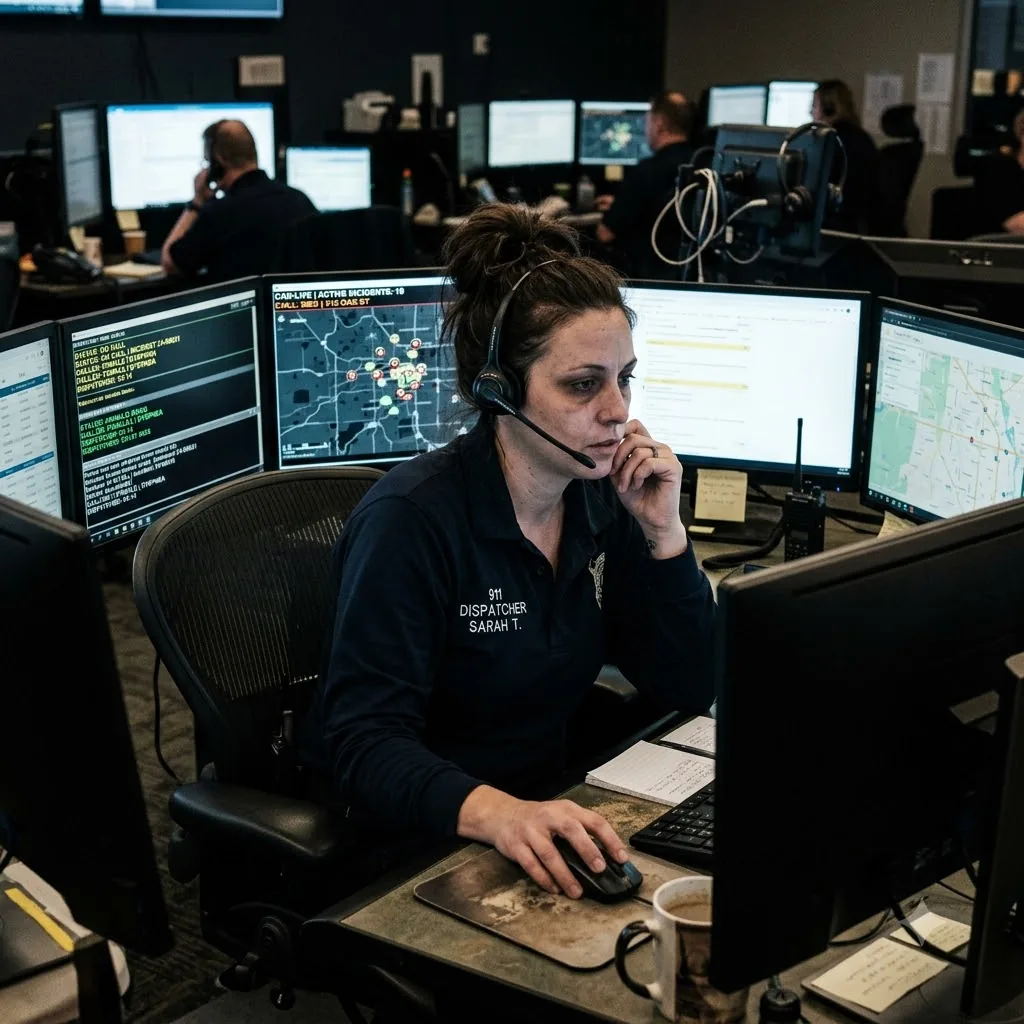
Across the dispatch floor, a red light blinks on a console in the first row. Incoming 911 call. A second later, another light illuminates on the third row. Then five more. Then twenty.
The massive digital queue board on the front wall of the center, which usually holds at most three or four pending calls on a Friday night, suddenly cascades with uniform red text. Ten calls. Thirty calls. Fifty calls.
“What is happening to the trunk lines?” Davis shouts, abandoning my desk and sprinting toward the main server hub. “Are we being DDOSed?”
I look at the incoming caller IDs flashing relentlessly on my own screen. They aren’t randomized numbers or spoofed spam lines. They are all originating from the exact same geographic prefix. Brenda’s neighborhood.
I click into the first one, my finger shaking. “911, what is your emergency?”
“Operator 42 is a traitor,” a synthesized, robotic voice states flatly over the line. “Remove her from the board. We control the sector now.”
I drop the call in shock. I immediately click the next flashing icon.
“Fire Operator 42,” a woman hisses, sounding exactly like Brenda but decades younger. “You are harboring criminals. We are watching you.”
I drop it. The board climbs to eighty pending calls, a physical impossibility for our center to process.
They aren’t just blocking the physical street to keep the police away from the driver. They are executing a coordinated phone tree attack to crash the city’s entire emergency grid, ensuring no backup can be dispatched to save him. And they are targeting me.