Story code: ST-001170
Part 3: The Playback
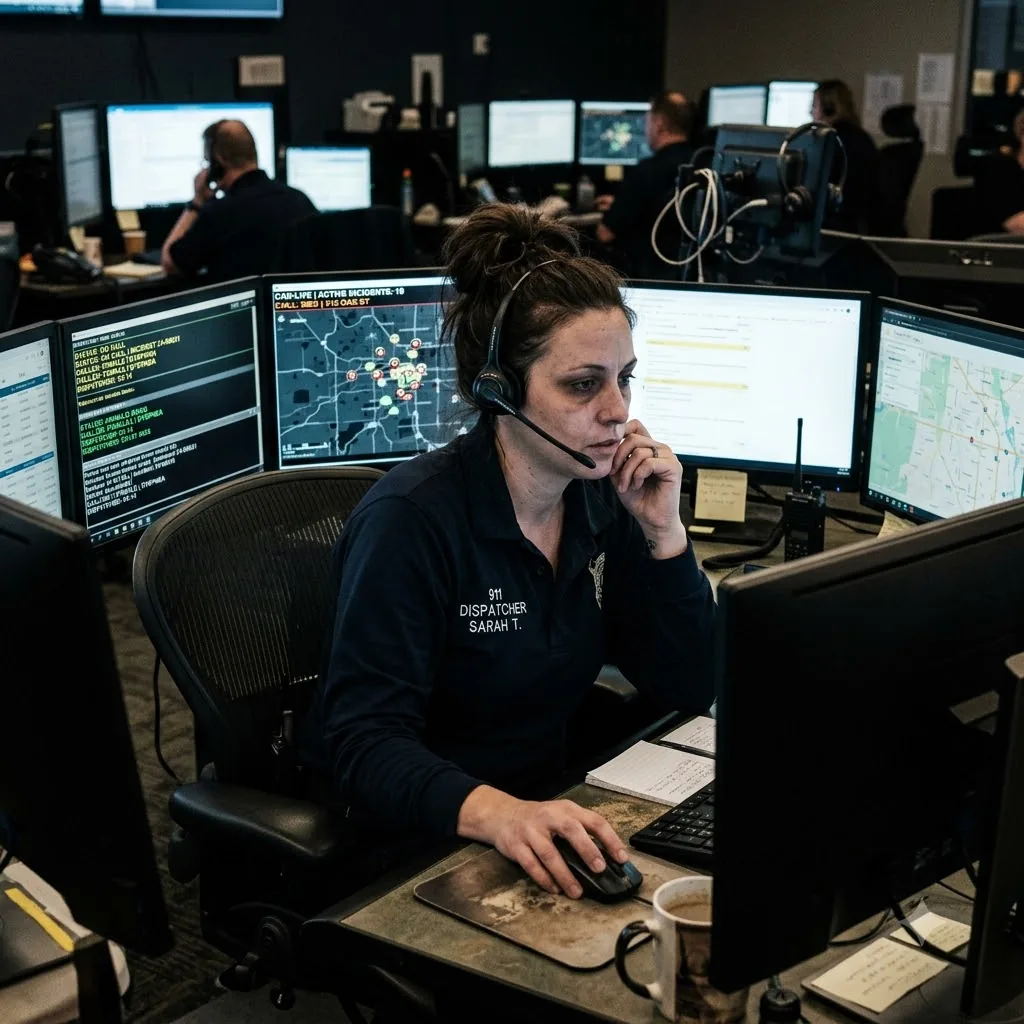
The Oakhaven Community Center smells like industrial floor wax and stale percolator coffee. It is entirely too bright. For five years, I have lived my professional life in the ergonomic, climate-controlled dark of the dispatch center, but tonight I am sitting in the third row of metal folding chairs under the relentless buzz of fluorescent tubes.
I am currently on week three of unpaid administrative leave, pending a city inquiry into my unauthorized use of an emergency override channel.
At the front of the room, Brenda Vance stands behind a veneer podium. She looks absolutely nothing like the breathless, terrified woman who held my emergency line hostage. She is wearing a cream-colored turtleneck and a silver watch, looking sharp, put-together, and deeply aggrieved. She is delivering the neighborhood watch’s monthly update using a PowerPoint presentation on a roll-away smart board.
“We protected our borders,” Brenda tells the room of about forty residents. They nod in unison. At least a dozen of them are wearing the neon yellow reflective vests of the community watch. “The city police abandoned us. The 911 dispatchers actively worked against us to protect criminals. But when that hostile individual breached my property line, we stood our ground. We kept Oakhaven safe.”
She clicks a remote in her hand. The smart board displays a still frame taken from her front porch Ring camera. It shows the delivery driver-a nineteen-year-old kid in a faded, oversized hoodie-holding a brown cardboard box, frozen in pixelated mid-stride on her front walkway.
“He was aggressive,” Brenda says, her voice steady, projecting righteous authority. “He refused to state his business. He was casing the property, looking into the front windows. And when I asked him to leave, he charged the door.”
I look down at my laptop resting on my knees. I have two files queued up on my desktop. One is the raw MP4 video file from that exact Ring camera, which Brenda’s husband proudly uploaded to the Nextdoor app the morning after the incident to prove their vigilance. The second is an encrypted .WAV file I dumped onto a flash drive from the dispatch center’s CAD archives before Davis escorted me out of the building by my elbow.
I close the laptop lid and stand up.
My metal chair screeches sharply against the linoleum. Forty heads turn toward me.
“Excuse me,” the HOA president, a balding man in a tight golf shirt, says from a folding table near the front. “This is a closed meeting for Oakhaven residents. Sign-in was at the door.”
I don’t stop walking. I bypass the front table, stepping directly into the open space next to the podium. Brenda frowns, taking a half-step back, her eyes darting toward the double doors at the back of the hall as if expecting the police officers she so deeply distrusts to suddenly swarm the room.
I place my laptop next to her presentation clicker. I reach down, pull the HDMI cable out of the community center’s tablet, and shove it directly into the port on my machine.
“Hey! You can’t do that!” the president barks, his chair scraping backward as he stands.
“I am Operator 42,” I say directly into the podium microphone.
The silence that falls over the room is absolute, heavy and suffocating. The shifting in the metal chairs stops. The coughing stops. Brenda’s face loses a fraction of its color.
“You’re the traitor,” a man in a yellow vest spits from the second row, though he doesn’t stand up. “You tried to send the cops to arrest Brenda.”
“I sent the police to prevent a murder,” I say. My voice carries the exact, flat, practiced cadence I use to de-escalate hostage situations. I open my laptop and tap the spacebar. “You’ve all seen the still photograph Brenda just showed you. Now, let’s watch the video. And more importantly, let’s listen to the audio.”
The smart board flickers, dropping Brenda’s PowerPoint and mirroring my desktop. I have layered the Ring camera footage side-by-side with the jagged green visual waveform of the 911 call audio.
I hit play.
The video starts. The room is silent except for the overhead speakers. Because the Ring camera audio was muted for the Nextdoor upload, the only sound in the room is the breathless, frantic, terrifyingly unstable voice of Brenda Vance, broadcast from my 911 file at maximum volume.
*”He is looking at the Adams house across the street. He has a cardboard package… They are sending people to map the perimeter.”*
On the screen, the teenager is just standing on the sidewalk. He is looking at a shipping invoice, completely unbothered. He checks a house number, then starts walking up Brenda’s path.
*”Return to your interior space immediately,”* my own recorded voice echoes coldly through the community center. *”Do not engage the driver.”*
*”I am not going to let them take our streets.”*
In the video, the teenager stops. He looks confused. He holds up the box, pointing to the shipping label. He is clearly mouthing the words, ‘I have a package.’
Then, the audio plays the sound.
*Clack-clack.*
The heavy, unmistakable metallic rack of the slide on a semi-automatic weapon.
In the community center, a collective, sharp gasp ripples through the folding chairs. The residents of Oakhaven are staring at the screen. In the video, the exact fraction of a second that the sound registers, the teenager violently flinches. He drops his hands. His shoulders hike up to his ears, and his eyes go wide with absolute terror.
*”Please, lady. I’m just dropping off the router. The company sent me to replace the router.”*
*”Don’t move! Greg! Get the perimeter! He’s trying to run!”*
On the screen, the kid isn’t advancing. He isn’t charging the door. He is stumbling backward, desperately trying to retreat, tripping over the edge of the manicured brick flowerbed. He drops the cardboard box on the concrete. He holds his empty hands up to shield his face.
*”I’m not running, I’m just backing up!”*
I hit the spacebar, pausing the playback. The video freezes on the teenager, cowering against the retaining wall, bracing for a bullet.
I turn my head to look at Brenda.
She is trembling. Her hands grip the edges of the veneer podium so tightly her knuckles are bone-white. The pristine narrative she had constructed, the righteous armor she had worn to justify the armed blockade of city streets, lies completely shattered on the eighty-inch display behind her.
I look out at the audience. The men in the yellow vests are staring fixedly at the frozen image of the cowering teenager. Not a single person is looking at Brenda. The defiant anger that had fueled their coordinated cyber-attack on the city’s 911 grid has evaporated, immediately replaced by a cold, sickening realization of what they had actually mobilized to defend.
“He was backing up,” the HOA president whispers into the dead air. He looks at Brenda, his voice laced with disgust. “You told us he charged you. You told us he reached into his waistband.”
Brenda opens her mouth, but no words come out. The podium microphone picks up only the jagged, uneven hitch of her breathing-the exact same panicked rhythm I had listened to in the dark of the dispatch center, right before she decided to play god.