Story code: ST-001574
Part 2: Paper Before Dawn
The woman with the tablet closed her hand around the cart handle as if it already belonged to the city.
Rosa pulled back at once.
“Don’t touch my things.”
The woman let go, but only after a beat that felt chosen. “Then move it out of the lane.”
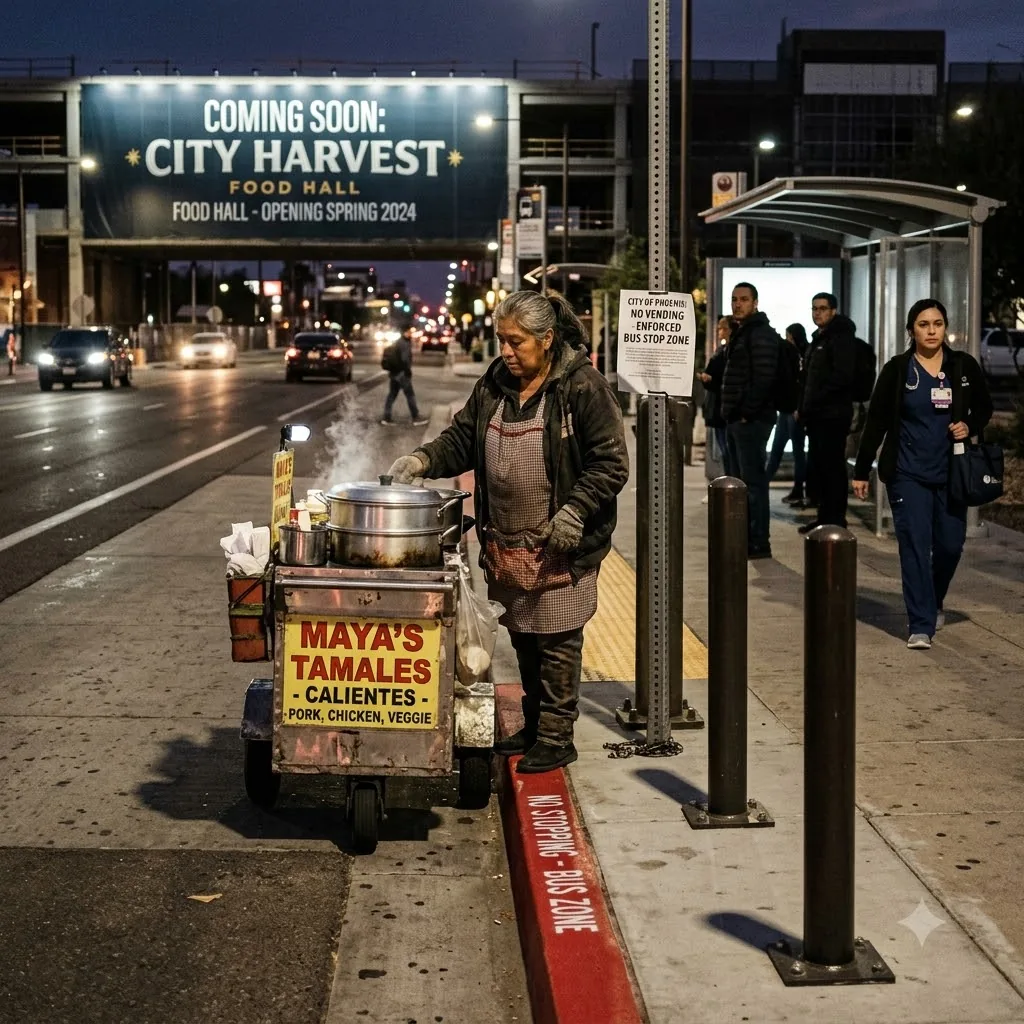
Now people were looking for a different reason. Not just the red curb, not just the bollards. The little flash of contact had changed the shape of the morning. A man getting off the second bus slowed with his phone halfway out of his pocket. The woman in pink scrubs stopped three steps short of the cart, still holding her money, eyes flicking from Rosa to the reflective jackets.
“She’s just selling breakfast,” the woman said.
“She is not selling,” the man with the clipboard answered. His voice stayed smooth, almost helpful. “And she cannot vend at this location.”
The way he said location made Rosa want to break something.
“I can move two feet and still be on the same sidewalk,” she said. “So tell me where this suddenly starts and where it ends.”
The woman with the tablet turned the screen toward herself and tapped twice. “This frontage and the adjacent bus zone.”
“Adjacent how much.”
“The posted area.”
Rosa laughed once, short and hard. “You mean the paper tied up where no one can read it before sunrise.”
The housekeeping worker came a little closer, still clutching his bills. “Can’t she set up by the tree?” he asked, nodding down the block.
The clipboard man did not even look. “Not without authorization.”
“From who?”
“Through the proper office.”
Everything in their mouths had been sanded smooth before they got there.
Rosa shoved her chain into the cart basket and stepped to the pole. This time she did not reach for the notice. She bent low enough to read the bottom edge where the fold had opened. Temporary Curb Safety Improvements, it said in bold. Beneath that, smaller words stacked in lines: pedestrian access, transit operations, emergency ingress, public welfare. The kind of language that could smother a person under clean shoes.
There was a date on it. Three days ago.
Three days.
She looked back at the inspectors. “Where was this mailed?”
The man with the clipboard shifted. “If notice was required, it was issued according to procedure.”
“That’s not what I asked.”
“Ma’am, I don’t handle distribution.”
Across the street the man in the black puffer vest finally crossed over, not to her but to the edge of the bus shelter. He kept his phone up and angled his body as if he were trying to seem casual and invisible at the same time. Rosa recognized him then, not his name but his face: one of the men who had stood in the hospital loading entrance last month with rolled plans under his arm, talking to security and pointing at the sidewalk.
He saw her see him and turned his head away.
The woman in pink scrubs followed Rosa’s gaze. “Do you know him?”
“I know he was here before the paint was dry,” Rosa said.
The clipboard man said, “Let’s keep this focused.”
“On what? On me being the only person here who wasn’t warned?”
A bus hissed into the red curb area and stopped short, farther down than usual. Passengers had to step around a puddle to get off. Two of them glanced over, annoyed first at the bus and only then at Rosa, as if she had become part of the obstruction by standing near where she had always stood.
The woman with the tablet spoke to the driver through the open door. “We’re clearing it now.”
Clearing it. Rosa felt that one land in her chest.
She dug into the plastic sleeve under the cart and yanked out her permit, her food handler card, the folded receipt for last month’s fee. Her fingers shook enough that the papers slipped crooked. She held them out. “Look. You want compliance, here. I paid. I renewed. I did what you people ask every time.”
The man with the clipboard glanced, then lowered his eyes to the page in his hand instead, as if her documents were beside the point. “Those do not override a posted restriction.”
“Then why did the city take my money?”
No answer. Only that mild face again.
The pink-scrubs woman took one more step forward. “Can I at least buy from her if she hasn’t even opened?”
“No transactions here,” the woman with the tablet said.
The customer looked at Rosa helplessly. “I’m sorry.”
Sorry did not buy masa or rent or propane.
Rosa turned to the housekeeping worker. “Take two from the side compartment and leave the money.”
The clipboard man moved fast for the first time. “Do not do that.”
His voice cracked sharp enough that half the people at the shelter looked over. The worker froze with his hand half-lifted.
“If service begins after notice,” the man said, louder now, “I am authorized to issue a citation and begin impound documentation.”
There it was. The polished reason with its teeth out.
Rosa folded her permit papers against her palm until the edges bit her skin. “For one tamale.”
“For unlawful vending in a restricted zone.”
The woman with the tablet had already opened another screen. Rosa could see boxes there, blank fields waiting to be filled. They had forms for her before breakfast.
Someone behind the shelter murmured, “Just move, lady.” Another voice answered, “They don’t let anybody do anything anymore.” Not support, not opposition. Just that flat public weather people put on when trouble belongs to someone else.
A hospital security guard came out from the side entrance, drawn by the stalled bus and the small knot of bodies. Rosa knew him by sight. He had bought coffee from the diner and brought it past her cart for years. Today he kept his hands on his belt and stopped beside the inspectors.
“Problem?” he asked.
The clipboard man answered before Rosa could speak. “Vendor enforcement. We’re asking for the lane to be cleared.”
The guard looked at Rosa, then at the red curb, then back to the inspectors. He did not smile. “You can’t block the bus zone, Rosa.”
Not Rosa, good morning. Not what happened. Just the rule, as if he had stepped into a script already underway.
“I got here and it was gone,” she said. “My spot. Overnight.”
He gave a small shrug that made room for sympathy without offering any help. “You should take it up with permitting.”
“They’re here now.”
“This is field staff,” the clipboard man said.
The guard nodded as if that settled something.
Rosa saw then how the morning had closed around her. The regulars needed to get to shifts. The buses kept coming. The people with badges belonged to systems that spoke to each other in the same careful language. Even the customers who wanted food were beginning to edge away because standing near her had started to look expensive.
Her phone buzzed in her coat pocket. She almost ignored it, then fished it out with stiff fingers.
Marta.
Her sister never called this early unless something had gone wrong with the garage or their mother.
Rosa answered. “What.”
Marta’s voice came thin and breathless through traffic noise. “Rosa, where are you? There was a tow truck at the garage when I got here. They said they had paperwork to remove unauthorized street-vending equipment from the property line and they asked for you by name.”
Rosa stopped hearing the buses for a second.
“What paperwork?”
“I don’t know. A man in a vest showed me a form through the window. And Rosa” – Marta lowered her voice – “there’s another city truck pulling up behind yours right now.”
Rosa looked up.
At the far end of the block, easing through the morning traffic with patient yellow lights turning, came a flatbed with a winch on the back and MUNICIPAL RECOVERY stenciled on the door.