Story code: ST-001574
Part 4: The Soft Language Was the Weapon
Nobody answered because there was no answer that would sound clean anymore.
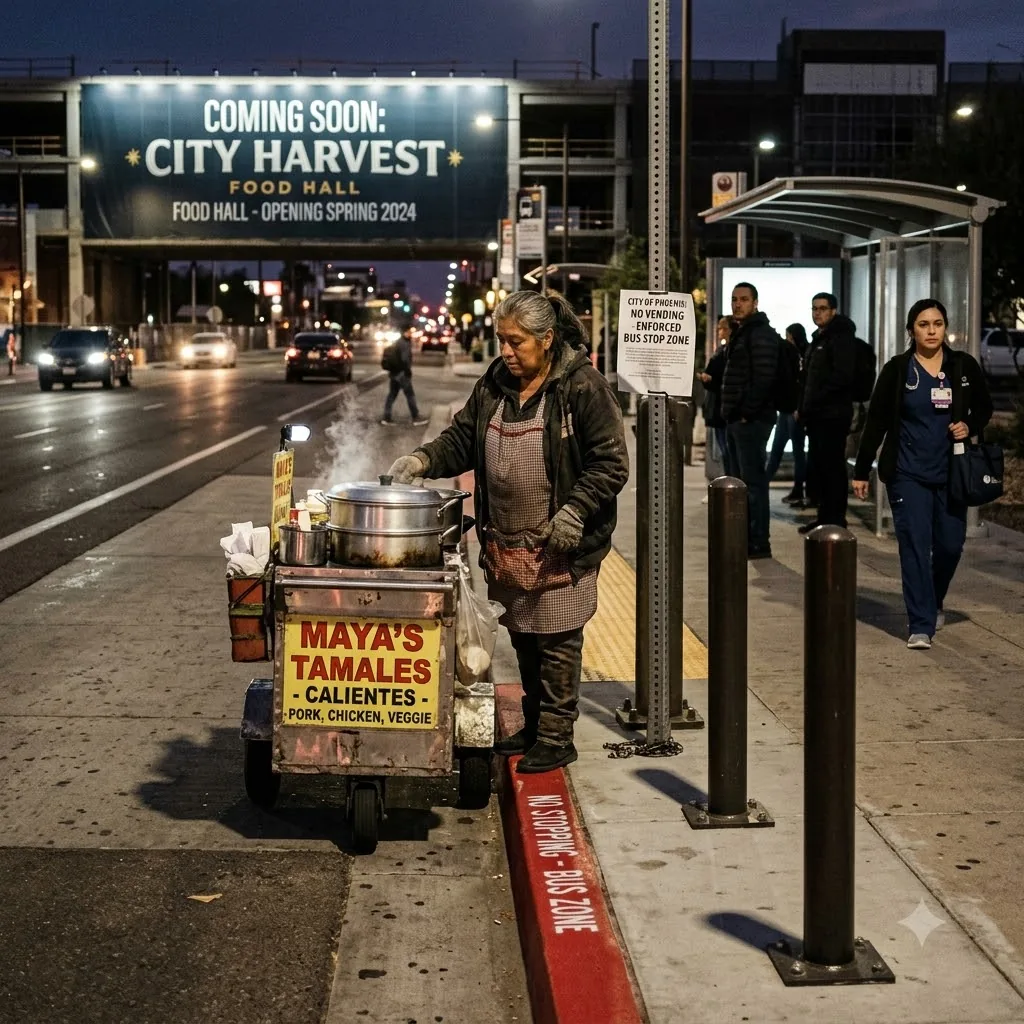
The pink-scrubs woman still had the brochure open. The housekeeping worker was reading over her shoulder. The security guard had stopped trying to look detached. Even the people who did not know the whole story could see enough of it now: Rosa’s cart at the curb, the city’s truck behind it, the glossy picture of a safer, prettier version of what she already did for a living.
The clipboard man drew in a breath and found his voice again, but not the old smooth one. “Today’s restriction remains in effect,” he said. “If the cart is not removed voluntarily, we will proceed with enforcement review.”
Review. Not impound now. Not citation now. A smaller word, chosen fast.
“Because people are watching?” Rosa asked.
He ignored that. “You need to clear the posted zone.”
The flatbed driver stayed where he was. The woman with the tablet lowered her screen. The man in the black vest had gone pale enough that the cold showed through his face.
Rosa understood then what she was and was not going to get. They were not going to reverse anything on the sidewalk. The bollards were still in the ground. The curb was still red. The morning rush was still moving around her instead of toward her. Whatever embarrassment she had forced into the open had only made them careful.
But careful was not nothing.
The pink-scrubs woman shut the brochure and held it against her chest. “What’s her name?” she asked the officials.
No one spoke.
“Exactly,” the woman said. She looked at Rosa. “I know your tamales are by the green salsa and the little burned corner on the foil. That’s what I know.”
She handed the brochure back only after the vest man reached for it with both hands, quick and ashamed. Then she took out her phone and photographed the red curb, the bollards, the city truck, and finally Rosa’s cart with its lid still closed.
The housekeeping worker did the same.
That started others. Not a crowd, not some grand uprising, just three more people at the shelter lifting their phones because it had become harder to pretend this was routine. The clipboard man saw it happening and changed his posture at once.
“We are not taking the cart at this time,” he said, loud enough for those phones to hear. “Vendor is being directed to relocate pending administrative clarification.”
There it was again. Not truth. Just better cover.
Rosa almost laughed. Relocate to where? There was nowhere near enough foot traffic down the block, nowhere legal that had not already been squeezed, nowhere that would replace the breakfast line she had built over eleven years one nurse and janitor and driver at a time.
Still, the flatbed did not move toward her cart. That was the concession. Thin, ugly, and real.
Her phone rang again. Marta.
Rosa answered without taking her eyes off the officials.
“They left,” Marta said at once. Her breathing was still high and uneven. “The garage crew left after I started reading the notice out loud and asking who signed it. They took pictures and left. But Rosa, they put a sticker on the side gate. It says inspection pending.”
Not gone, then. Delayed.
“Did they touch anything?”
“No. But the upstairs tenant came down. She heard all of it.”
Rosa closed her eyes for one beat. Another loss. Not property this time. Standing. Privacy. The little dignity of having your work stay your own business.
“I’m coming when I can,” she said.
When she hung up, the clipboard man was already stepping back toward the pickup. “You have been informed of the restriction,” he said. “Further questions can go through the posted channels.”
Posted channels. Hearing channels. Appeals process. Administrative clarification. They never ran out of soft cloth to wrap around a blade.
The security guard shifted his weight and finally looked at Rosa directly. “Rosa,” he said, low now, almost human again, “if you stay here, they’ll make it worse.”
He was probably right. That made it no easier to hear.
She put her permit papers back into the plastic sleeve with careful hands. The same permit, the same fees, the same city seal that had not protected one inch of pavement for her. Then she gripped the handle and backed the cart away from the curb she could no longer use.
The movement felt public in a way standing there had not. Defeat always did.
The pink-scrubs woman followed her two steps. “Where will you be tomorrow?”
Rosa started to say she did not know.
Before she could, the housekeeping worker said, “St. Brigid lot. Father Tom lets the vaccine van park there on weekends. My cousin runs the pantry.”
The pink-scrubs woman caught on immediately. “Across from employee parking?”
“South gate,” he said. “Half a block. Off the red curb.”
The two of them looked at Rosa, waiting.
It was not legal permission. Not a fix. Not her corner back. It was church asphalt and favors and people deciding the city did not get to make them strangers overnight.
Rosa nodded once. “If I can set up there, six-thirty. Tell only the people who buy breakfast, not everybody’s cousin.”
That got the first small smile she had seen all morning.
“Done,” the woman said.
By the time Rosa reached the end of the block, her usual line was gone. Shift change had happened without her. The money in her cash apron was exactly what it had been when she left home: almost nothing. She could feel the day’s loss already adding itself up in masa, meat, gas, hours, and rent. The city had not taken the cart, but it had taken the morning, which was another way of taking a week’s edge off a person who lived close.
Marisol called while Rosa waited at the light with both hands braced on the handle.
“I heard,” she said without preamble. “Three people already sent me pictures. Don’t say anything else on the phone. Save every notice. I want the hearing packet, the board minutes, the curb order, all of it.”
Rosa looked back once. The vest man was getting into the SUV with his brochure hidden again. The white pickup was pulling out. The red curb remained, bright and innocent from a distance.
“I thought they were just talking fancy,” Rosa said.
“They were,” Marisol answered. “That’s how they do it.”
Rosa crossed on the walk signal, pushing the heavy cart toward a day that would not pay what it should have. Around her the hospital kept swallowing workers through every entrance. Above the new paint and steel and notices, the morning looked ordinary enough to fool anyone passing by.
That was the clearest part now.
Nobody had needed to shout at her to move. Nobody had needed to call her a problem. They had used kinder words than that. Safety. Access. Welfare. Revitalization. Compassion.
By the time Rosa turned onto the side street, she knew which part would stay with her longer than the lost sales or the red curb or even the brochure picture of her life cleaned up for somebody else.
It was not that they had come for her space.
It was that they had come smiling.