Story code: ST-001574
Part 3: The Hearing Uses the Word Compassion
The flatbed did not rush.
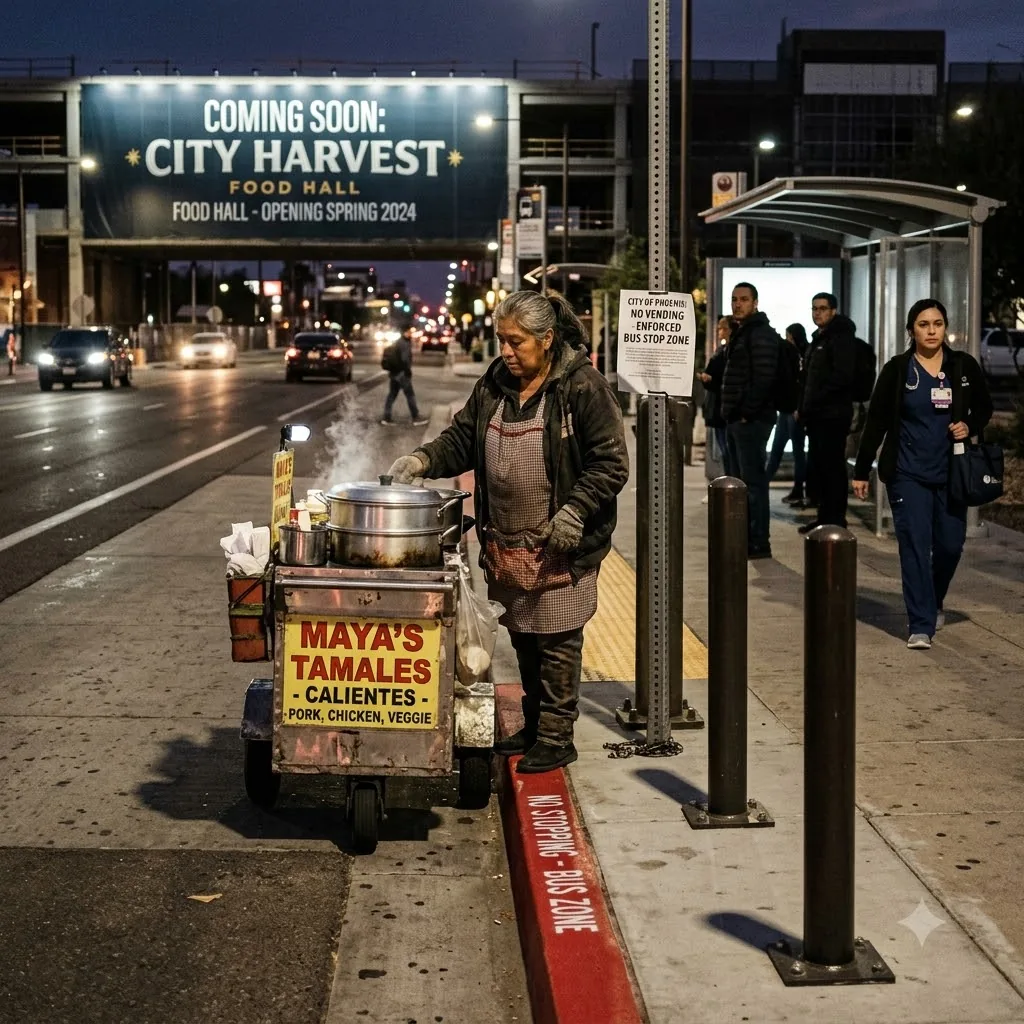
That was the worst part of it. It came up the block with its amber lights turning slow and lazy, as if this had already been decided somewhere indoors by people with coffee in front of them. The driver wore a city jacket and kept one wrist draped over the wheel. He did not look at Rosa until he was almost even with the bus shelter.
Then he looked once, checked the cart, and pulled in behind the white pickup.
The woman with the tablet took two steps toward him. The clipboard man met him halfway. They spoke close, backs turned, while the driver glanced over their shoulders at Rosa’s cart and then down at a packet clipped to a board. None of them looked surprised to see each other.
Rosa still had Marta on the phone.
“Don’t let them take anything from the garage,” she said.
“I’m trying,” Marta answered. There was shouting behind her, a metal door rolling, somebody saying ma’am in that falsely calm way. “They keep saying they only need to verify inventory. Rosa, there’s a notice on the gate from the neighborhood board. Why would the neighborhood board be on our gate?”
Rosa went cold under her jacket.
“What board?”
“The East Mercado board. The one that did those listening meetings at the library.”
Rosa looked across the street again at the man in the black puffer vest.
He was no longer pretending not to watch. He had lowered his phone and tucked it under his arm. In the gray morning she could place him now, not just from the loading dock with the rolled plans but from a Tuesday night three months ago in a school auditorium with bad fluorescent lights, where people had stood at a microphone and talked about safety, and sidewalks, and families walking to the new market district. He had been near the front then too, sitting beside a woman with a sharp white bob and a silk scarf who kept saying balanced growth like she had coined it herself.
The board chair.
Marisol had nudged Rosa’s elbow that night and whispered his name, though Rosa had forgotten it. Not forgotten the face. Not forgotten how he had passed thick color packets down the row before public comment started.
“Stay there,” Rosa told Marta. “Don’t sign anything. Put me on speaker if they talk to you.”
She ended the call instead. The man in the vest had started edging backward toward the curb, reading her expression too late.
“You,” Rosa said.
Her voice cut farther than she expected. The pink-scrubs woman stopped in the act of leaving. The security guard turned back from the hospital doors. Even the flatbed driver lifted his head.
The man in the vest gave the small smile of somebody preparing to be reasonable. “I don’t think I can help here.”
“You were at the board hearing.”
“Ma’am-”
“You had the drawings.”
The clipboard man stepped in at once. “This is not relevant to today’s enforcement action.”
Rosa did not take her eyes off the vest. “You stood next to the woman from East Mercado and handed out the packets with the pretty trees and the lights over the tables.”
The vest man’s smile tightened. “I’m with community outreach.”
“For who.”
“We’re discussing a separate project.”
The phrase landed with too much practice. Separate project. Rosa heard the seam in it.
The pink-scrubs woman said, “What project?”
Nobody answered her.
The man in the vest shifted his phone from one hand to the other. When he did, a glossy folder slid out from under his arm and hit the sidewalk faceup.
A photograph filled the front: strings of warm bulbs, concrete counters, young people smiling over paper trays of food. At the top, in polished green letters, EAST MERCADO FOOD HALL. Under that: Authentic local flavor for a new neighborhood.
Rosa saw it before he could snatch it up.
So did the housekeeping worker.
“That’s the place going in by the old depot,” he said.
The pink-scrubs woman bent faster than the vest man and picked up the folder. He reached for it. She held it back long enough to read the cover, then opened it by instinct.
Inside was a rendering of a corridor lined with stalls. Painted signs. Hanging plants. At one counter a woman in an apron stood behind a stainless-steel warmer under a hand-lettered sign that said Tamales de la Casa.
Rosa knew that exact style of striped cloth draped across the counter. She had used one like it for years to cover the crate where she kept napkins and spoons.
“Give me that,” the vest man said.
The clipboard man spoke over him, louder. “Please return private materials and step away from the work area.”
Private materials.
The pink-scrubs woman looked from the brochure to Rosa’s cart and back again. “Are you kidding me?”
The woman with the tablet said, “This has nothing to do with the posted safety modifications.”
“Then why is the neighborhood board notice on her garage gate?” Rosa asked.
Silence.
Not full silence; buses still sighed, engines still idled, somebody down the block dropped a dolly hard onto concrete. But inside the little circle at the curb, everybody stopped finding the next smooth sentence.
Rosa took one step toward the vest man. “Who gave them my garage address?”
He looked at the clipboard man instead of at her.
That was enough.
Marisol’s voice came back to Rosa from the hearing as clear as if she were standing there now: They call it corridor activation when they want to clear the corridor first.
At the time half the room had rustled and looked annoyed. Rosa had not understood all of it. She understood now.
The security guard said, uncertain now, “Is this about that food hall thing?”
The housekeeping worker answered before anyone official could. “They got cooks in there selling tacos for sixteen dollars.”
“Local concepts,” the pink-scrubs woman read from the brochure. Her face changed on the words. She flipped another page. “Curated street-food tradition.”
Rosa laughed then, but there was no humor in it. Just air cut sharp through her teeth.
Curated.
She could smell the masa still warm inside her cart. Could feel the ache in her shoulders from pushing it through dark streets for years while people in offices found words for her that would sell better under clean lights.
The woman with the tablet recovered first. “Again, these are unrelated matters. Today’s action concerns transit safety and emergency access.”
“Three days after your board hearing minutes go online,” Rosa said.
The vest man flinched.
She saw that too. She had not even known if the minutes were online. Marisol had texted her once after a meeting telling her to read them, and Rosa never had. But the man’s face gave it away before he could arrange it.
“What minutes?” the pink-scrubs woman said.
Rosa kept going because the crack was there now and she could feel it widening. “The hearing where the chair thanked stakeholders for supporting a safer pedestrian experience around the hospital corridor. The hearing where your packets were already printed. The hearing where nobody said vendors by name but everybody knew which curb they meant.”
The clipboard man lifted his page like a shield. “If you have concerns about public meetings, there are channels-”
“Answer one thing,” Rosa said.
He stopped.
The flatbed driver had not moved. He stood by his truck with his hands in his jacket pockets, no longer pretending this was just another pickup.
Rosa pointed at the brochure in the pink-scrubs woman’s hand. “Did the same people praising compassion and small business support this restriction before they came for my space?”
No one answered.
She pointed at the vest man. “Were you at that hearing for outreach, or for sales?”
His mouth opened. Closed.
She turned to the woman with the tablet. “Why is a neighborhood board posting on my family’s garage if this is only transit safety?”
The woman looked to the clipboard man.
Rosa turned to him last. “And if this is only a red curb, why did your tow crew ask for me by name at a different address before sunrise?”
The clipboard man held very still. The polished words were gone from his face now, and what showed through was not authority but the effort of deciding which lie could survive the next thirty seconds.
Behind Rosa, someone at the bus shelter said quietly, “Damn.”
The pink-scrubs woman lowered the brochure just enough for everyone to see the page with the smiling tamale counter.
The amber lights from the flatbed kept turning over all of them, slow and patient, while nobody from the city had a clean answer ready.